Why Every Company Needs IP Vulnerability Scanning (And Why Humans Still Matter)
Modern businesses of every size now operate on public IP addresses, cloud resources, and internet-facing services. Each exposed IP is a potential front door for attackers - and they are constantly knocking. An IP vulnerability scanner is one of the most effective ways to find weaknesses before an attacker does, but relying on fully automated tools without human oversight introduces its own operational and security risks.
The most resilient approach combines continuous IP vulnerability scanning with human verification and guided remediation. That combination improves security while reducing noise, outages, and unnecessary business disruption.
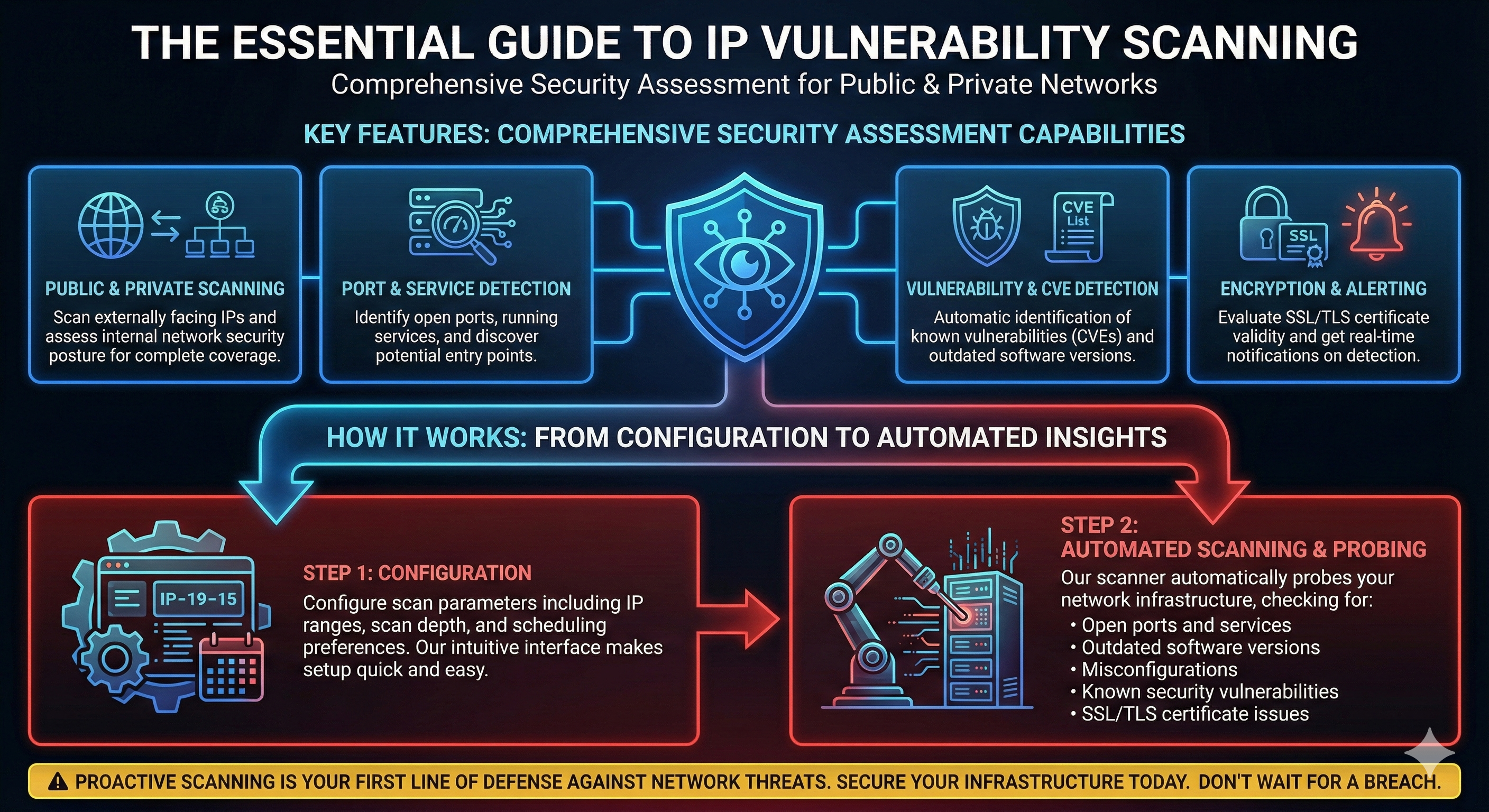
1. Why IP Vulnerability Scanning Matters for Companies of Any Size
An IP vulnerability scanner systematically examines internet-facing IPs and the services behind them to identify known weaknesses that attackers could exploit. This is no longer just an "enterprise" concern.
Even small organizations typically expose:
- Websites and APIs
- VPNs and remote access gateways
- Email and collaboration tools
- Cloud workloads and management endpoints
- Third‑party integrations and webhooks
Attackers do not manually guess who to target; they use automated tools to scan huge IP ranges looking for open ports, outdated software, and misconfigurations. Any exposed service on an IP can be detected and probed in seconds.
An IP vulnerability scanning solution typically helps security teams to:
- Map external attack surface: Enumerate live IPs, hosts, open ports, and services across cloud and on‑prem environments.
- Identify exploitable weaknesses: Match detected software and configurations against known vulnerabilities and misconfigurations (for example, outdated services, weak protocols, publicly exposed admin panels).
- Track drift over time: Highlight new exposures that appear after deployments, configuration changes, or new vendor integrations.
- Support compliance: Many standards and regulations expect or require regular vulnerability assessments of external systems.
Without this kind of systematic external view, even a relatively simple environment can accumulate risky exposures surprisingly quickly.
2. What Can Go Wrong Without IP Vulnerability Scanning
Skipping or de‑prioritizing IP vulnerability scanning is essentially accepting blind spots at the edge of the environment. The practical consequences can be severe.
Unknown or forgotten internet‑facing assets
New cloud resources, test environments, and third‑party tools are often spun up quickly and not always added to asset inventories. Without IP‑based discovery and scanning:
- Old test systems may remain online with default credentials.
- Deprecated APIs may still be reachable and unpatched.
- Temporary firewall or load balancer rules may unintentionally expose services long after a project ends.
These overlooked assets are prime targets because they often receive the least attention.
Unpatched and misconfigured services
An IP vulnerability scanner can detect common issues such as:
- Unnecessary open ports and legacy protocols
- Outdated software versions with known CVEs
- Misconfigured TLS, weak ciphers, or insecure remote access
- Exposed admin consoles, databases, or message queues
Without regular scans, these weaknesses can persist for months or years. Attackers actively search for these specific patterns and use off‑the‑shelf tools to compromise them.
Compounded business impact when incidents occur
When an externally exposed vulnerability is exploited, the impact is rarely limited to a single server. The downstream consequences can include:
- Ransomware or destructive malware entering through an exposed service, then moving laterally.
- Data theft from internet‑facing applications, APIs, or storage endpoints.
- Service outages from denial‑of‑service attacks, cryptomining, or account takeover.
- Regulatory and contractual issues where regular external vulnerability management was expected but not performed.
Incident response becomes far more complex if there is no baseline of prior IP scan results. Security teams must first figure out what "normal" even looked like before understanding how the attacker got in.
3. The Risks of Relying Only on Traditional or Fully Automated Scanners
An IP vulnerability scanner is essential, but a fully automated "set and forget" model creates its own risks. Tools are powerful, but not infallible.
False positives: noise, wasted time, and alert fatigue
Automated scanners often generate false positives - finding "vulnerabilities" that are not exploitable or not relevant to the actual environment.
This happens for reasons such as:
- Inexact CVE matching: Scanner signatures may loosely match software names or versions, associating vulnerabilities with the wrong product or configuration.
- Lack of contextual awareness: A finding may be technically present but mitigated by compensating controls, network segmentation, or surrounding architecture - context that a scanner cannot see.
- Generic checks on custom environments: Standard tests may not account for how a particular application or service is deployed.
False positives erode trust. Security teams end up spending substantial time proving that issues are not real, which can take longer than fixing a genuine vulnerability. Over time, stakeholders may start to discount or ignore scanner output, increasing the chance that a real, high‑risk issue is overlooked.
False negatives: missing real exposure
The opposite problem - false negatives - can be even more dangerous. These occur when an automated IP vulnerability scanning solution fails to detect a real vulnerability or exposure.
Common causes include:
- Incomplete or inconsistent vulnerability data feeding scanner signatures.
- Failure to accurately identify software versions or configurations behind a given port.
- Difficulty analyzing certain frameworks, protocols, or custom services.
The result is a false sense of security: dashboards appear clean, but exploitable weaknesses still exist on public IPs.
Operational and availability risks
Aggressive or poorly tuned automated scanning can also affect production environments:
- Performance degradation: High‑intensity scans can consume bandwidth or overwhelm fragile services and appliances.
- Triggering rate limits or security controls: Repeated probing may cause upstream providers, WAFs, or IDS/IPS to block IPs, throttle traffic, or trigger incident processes.
- Overblocking based on noisy results: In response to alarming but unverified findings, teams may deploy broad firewall rules, block entire IP ranges, or disable services preemptively - disrupting legitimate users and business operations.
An IP vulnerability scanner that operates without human oversight can therefore increase operational risk, particularly for production environments that require high availability.
4. Why Human Involvement in Verification and Remediation Matters
Automation is essential for scale, but human expertise is essential for accuracy, safety, and meaningful risk reduction. A balanced IP vulnerability scanning approach intentionally combines both.
Human triage and validation
Security teams can review scanner output to:
- Confirm whether a detected vulnerability is genuinely present and exploitable in the specific deployment.
- Take into account business context, data sensitivity, exposure level, and existing controls.
- Suppress or tune recurring false positives to reduce noise over time.
This triage step turns a raw list of potential issues into a curated set of real, prioritized risks.
Prioritized, realistic remediation plans
Not every vulnerability carries the same urgency. Human reviewers can:
- Group related findings into coherent remediation tasks (for example, "upgrade all exposed VPN gateways" instead of addressing each IP separately).
- Coordinate changes with application owners, operations, and business stakeholders.
- Align remediation work with maintenance windows, capacity planning, and release cycles to minimize business disruption.
Instead of reactive fire‑drills every time a scan runs, remediation becomes an ongoing, manageable part of engineering and IT operations.
Safer execution in production environments
Human oversight is especially important when scanning and fixing issues on live, internet‑facing systems:
- Security teams can choose scan profiles and schedules that reduce performance impact on critical services.
- Fragile or high‑risk systems can be excluded, scanned with gentler techniques, or tested first in non‑production environments.
- Rollout plans for patches, configuration changes, and firewall updates can include rollback strategies and monitoring checkpoints.
This reduces the risk that vulnerability management itself becomes the cause of outages or incidents.
Continuous tuning and learning
Over time, security teams can refine how an IP vulnerability scanner is used:
- Adjusting signatures, thresholds, and scopes based on what proves useful or noisy.
- Incorporating lessons from incidents, penetration tests, and architecture changes.
- Updating tagging and asset classification so findings can be routed automatically to the right owners.
This feedback loop is something automated tools cannot drive on their own. Human judgment closes the gap between theoretical scanner capabilities and practical, organization‑specific security outcomes.
Closing Thoughts
IP vulnerability scanning is no longer optional for any organization that operates services on the public internet. An IP vulnerability scanner provides the breadth and speed needed to keep up with constantly changing external exposure. Without it, blind spots accumulate until they are discovered under the worst possible circumstances - during or after an attack.
At the same time, relying solely on traditional or fully automated scanners introduces its own problems: false positives, false negatives, and avoidable operational risks. The most effective and sustainable model is a balanced one, where an IP vulnerability scanning solution is paired with deliberate human verification and thoughtful remediation.
In that model, the scanner supplies coverage and visibility, while security teams supply context and judgment. Together, they turn raw scan output into reliable, low‑risk improvements to an organization’s real‑world security posture.
Refrences
- https://www.intruder.io/blog/what-is-vulnerability-scanning
- https://www.e-spincorp.com/automated-web-vulnerability-scanners-limitations/
- https://www.cycognito.com/learn/vulnerability-assessment/vulnerability-scanning-process.php
- https://wjaets.com/sites/default/files/WJAETS-2024-0348.pdf
- https://www.wiz.io/academy/vulnerability-scanning
- https://www.securitymetrics.com/learn/vulnerability-scanning-101
- https://www.invicti.com/white-papers/false-positives-in-application-security-whitepaper
- https://qualysec.com/external-vulnerability-scanning/
- https://www.intruder.io/blog/internal-vs-external-vulnerability-scanning
- https://www.enterprisestorageforum.com/software/external-vs-internal-vulnerability-scan/