Why Every Company Needs CSPM: From Startup to Enterprise - And Why Human Verification Matters
The Silent Killer of Cloud Security: A Crisis That Spans All Company Sizes
If you think cloud security posture management (CSPM) is only for Fortune 500 companies, think again.
99% of cloud security failures are the customer's fault, according to Gartner - primarily due to misconfigurations. And here's the kicker: this threat doesn't discriminate. Whether you're a bootstrapped startup with 10 employees or a multinational corporation, a single misconfigured cloud storage bucket can expose millions of records, trigger regulatory fines, and tank your reputation overnight.
The numbers are sobering. Cloud misconfigurations cause 15% of all breaches and are the third most common attack vector in 2024. Yet companies continue to operate without proper visibility into their cloud posture, treating it like a "set it and forget it" problem. That's no longer viable in 2025.
This isn't just a technical issue anymore - it's a business crisis waiting to happen.
Every mention of teleport.it can be removed cleanly by reframing the blog as vendor-neutral and talking about "security teams," "CSPM platforms," or "this approach" instead of a specific product.
Below is a rewritten, neutral version of the post with all direct product references removed while preserving the "human-verified remediation" angle.
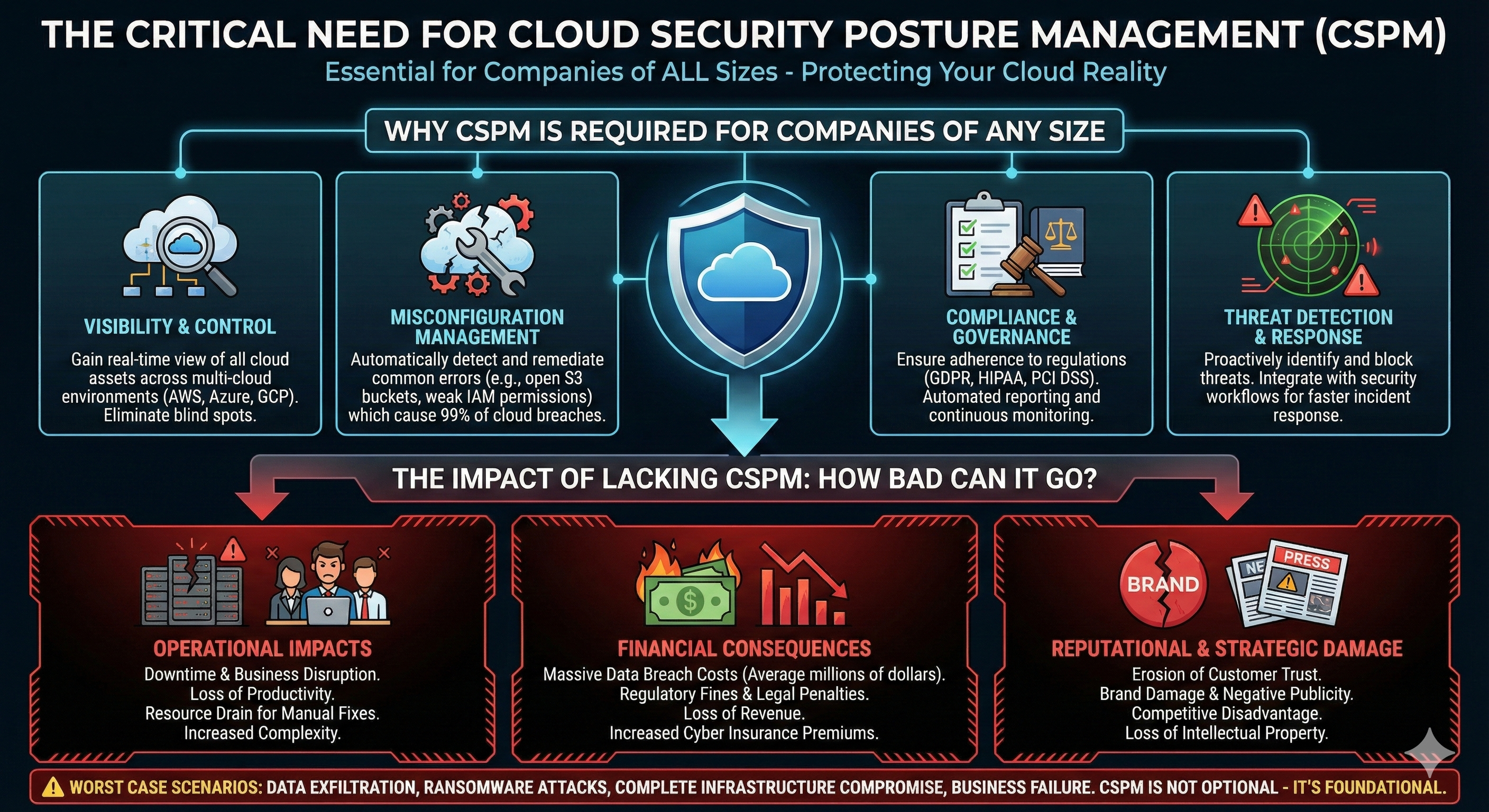
The business impact when CSPM fails
Hidden costs of a single misconfiguration
The financial impact of a cloud breach driven by misconfiguration extends far beyond initial triage.
Typical cost components include:
- Incident response, forensics, and recovery work
- Customer notification, legal counsel, and regulatory reporting
- Potential regulatory fines and settlements
- Emergency investments in security controls and consultants
Well-known public cases show that fines and legal settlements alone can reach tens or hundreds of millions of dollars after a cloud configuration error. For small and mid-sized organizations, even six‑figure breach costs can be existential.
Operationally, outages during containment and remediation can disrupt revenue streams, degrade customer trust, and lead to missed SLAs, while long-term impacts include higher cyber insurance premiums and ongoing regulatory scrutiny.
Compliance pressure
Organizations handling customer data are typically subject to frameworks such as GDPR, HIPAA, PCI-DSS, SOC 2, or ISO 27001, all of which assume that cloud configurations are appropriately controlled and monitored. Misconfigurations that expose personal data or weaken access controls can be interpreted as compliance failures and lead to substantial penalties.
The challenge increases in multi‑cloud environments: a large majority of organizations now use more than one cloud provider, each with different configuration models and security baselines. Without CSPM, keeping these environments aligned with security and compliance requirements is extremely difficult.
Why size does not protect you
Threat data shows that a substantial share of attacks target small and mid‑sized organizations, not just global enterprises.
- Smaller organizations often lack dedicated security teams, making human error and unchecked misconfigurations more likely.
- Mid‑market organizations frequently outgrow manual processes faster than they can formalize cloud governance.
- Large enterprises face sprawling, complex environments where a single misconfiguration can have systemic impact.
In all cases, misconfigurations are a universal risk, not something limited to a particular tier of the market.
Why detection alone is not enough
The CSPM market has been growing rapidly, with multiple analysts projecting strong double‑digit annual growth as organizations adopt tools for continuous posture monitoring. Many platforms excel at scanning configurations, identifying risky settings, and generating large numbers of alerts.
However, most CSPM implementations stop at detection or rely heavily on automated remediation. Teams are left with flooded dashboards and backlogs of findings but limited capacity to handle them thoughtfully.
This "detect‑only" or "detect‑and‑auto‑fix" model can create its own set of problems if not carefully controlled.
The automation paradox: when speed creates new risk
False positives and noisy alerts
Automated security systems inevitably generate false positives, especially in dynamic cloud environments with diverse workloads and rapidly changing configurations.
High false positive rates cause issues such as:
- Alert fatigue, where teams mute or ignore alerts
- Reduced trust in tooling
- Risk that genuine high‑severity findings are overlooked
Some organizations have reported cases where relying on automated blocking or remediation based on noisy intelligence led to legitimate traffic or customer resources being disrupted.
When auto‑remediation goes wrong
Auto‑remediation promises speed: a rule triggers, and the system instantly changes a configuration to "fix" the issue. But if the rule is incomplete or the context is misunderstood, the remediation can break production services.
Examples include:
- Aggressively tightening network rules and unintentionally cutting off critical integrations
- Modifying IAM policies in a way that disables key workflows
- Rolling back settings that a development or ops team intentionally configured for valid use cases
In such cases, automated fixes become the source of outages, not the solution. Recovery efforts then span incident response, rollback, and often unscheduled architectural work to prevent recurrence.
Why automation without verification is fragile
Fully automated remediation implicitly assumes that:
- The detection logic is accurate
- The same fix is safe across different environments and business contexts
- There are no hidden dependencies or side effects
- Configuration changes will not be immediately undone by other systems or processes
Real environments rarely meet those assumptions consistently. As a result, unverified automation can introduce instability and erode trust between security and engineering teams.
Human‑verified remediation: balancing safety and speed
An alternative model is to combine automated detection with human‑verified remediation. In this approach, tooling still does the heavy lifting of identifying misconfigurations at scale, but humans stay in the loop before impactful changes are applied.
A typical human‑verified remediation workflow looks like this:
-
Detect Automated scanners continuously monitor cloud accounts for risky configurations such as exposed storage, overly permissive IAM roles, unencrypted data stores, or non‑compliant network rules.
-
Validate the finding Security practitioners review the flagged issue to determine whether it is a true risk or a false positive. This reduces noise and prevents unnecessary changes.
-
Analyze context The team assesses the configuration in context: environment (prod vs. dev), business criticality, ownership, service dependencies, and any known exceptions.
-
Design and approve the fix A remediation plan is proposed and reviewed by security and, where appropriate, application or platform owners. The goal is to close the security gap while minimizing impact.
-
Execute with control Changes are applied with appropriate change management, logging, and rollback strategies. Monitoring is in place to detect unexpected side effects.
-
Verify and prevent regression Post‑change validation ensures the misconfiguration is resolved and does not reappear, often backed by continuous CSPM monitoring.
This model still benefits from automation for scale and visibility, but places human judgment between detection and change, especially for high‑impact resources.
Why organizations value human involvement
Peace of mind for operations teams
Operations and product teams are understandably cautious about tools that can change configurations autonomously. Knowing that a person has reviewed and approved remediation steps reduces fear that a "security robot" might accidentally take critical systems offline.
Human‑verified remediation gives stakeholders confidence that business impact has been considered and mitigated before changes reach production.
Lower operational risk
By filtering false positives and validating remediations, organizations reduce the chance that security controls themselves cause incidents. This is especially important for customer‑facing platforms and revenue‑critical services.
Instead of spending time recovering from automation mistakes, teams can focus on genuine threats and hardening work that actually reduces risk.
Stronger compliance story
Regulators and auditors increasingly ask not only whether issues are detected, but how organizations ensure that remediation actually closes gaps and is appropriately governed.
A documented human‑in‑the‑loop remediation process supports:
- Clear ownership and accountability
- Traceability of decisions and approvals
- Evidence that fixes were tested and verified
This strengthens an organization’s posture during audits for frameworks like SOC 2, ISO 27001, and sector‑specific regulations.
Better continuity for any company size
Whether a small startup or a large enterprise, most organizations prefer improvements in security posture without unplanned downtime.
Human‑verified remediation helps ensure that:
- Security changes are coordinated with development and operations
- Critical time windows (e.g., peak traffic) are respected
- Rollback options are ready if unexpected behavior appears
This balance is particularly important for smaller teams that cannot afford frequent, automation‑induced outages.
CSPM as a foundation, not a luxury
CSPM has become a foundational layer of modern cloud security rather than a luxury for a few large organizations. Growing adoption across industries reflects recognition that cloud misconfigurations are both common and highly impactful.
For organizations evaluating or evolving CSPM strategies, a key design choice is how much control to hand over to automation versus how much to keep humans in the loop. Fully autonomous remediation maximizes speed but can introduce new operational risks, while human‑verified remediation emphasizes safety and context awareness.
A balanced approach - automated detection plus human‑reviewed, controlled remediation - can provide strong security, better compliance support, and peace of mind that security changes will not unexpectedly bring systems down.
Reference
- https://orca.security/resources/blog/what-is-cspm/
- https://fidelissecurity.com/threatgeek/threat-detection-response/cloud-misconfigurations-causing-data-breaches/
- https://www.sentinelone.com/cybersecurity-101/cloud-security/cloud-misconfigurations/
- https://www.ilink-digital.com/insights/blog/financial-impact-cyber-breaches-business-costs/
- https://www.vikingcloud.com/blog/the-real-cost-of-data-breach
- https://purplesec.us/learn/data-breach-cost-for-small-businesses/
- https://www.scrut.io/post/cspm-the-ultimate-guide
- https://www.sentinelone.com/cybersecurity-101/cloud-security/cloud-security-statistics/
- https://www.cloudtech.com/resources/smb-cloud-adoption-trends-impact
- https://cloudlytics.com/unlocking-the-power-of-cloud-security-posture-management-for-small-and-medium-sized-businesses-smbs/
- https://www.linkedin.com/pulse/cloud-security-posture-management-market-report-7fqzf
- https://www.fortunebusinessinsights.com/cloud-security-posture-management-market-113864
- https://www.mordorintelligence.com/industry-reports/cloud-security-posture-management-market
- https://orca.security/glossary/false-positive/
- https://orca.security/resources/blog/manage-security-risks-auto-remediation/
- https://www.elastic.co/blog/false-positives-automated-siem-investigations-elastic-tines
- https://abusix.com/blog/no-amount-of-automation-can-help-threat-intelligence-riddled-with-false-positives/
- https://cymulate.com/blog/automated-vulnerability-remediation/
- https://tamnoon.io/academy/remediation-validation/