How to Monitor Cloud Security Posture: A Practical AWS Guide
Security posture monitoring sounds abstract until your AWS account shows up in a breach report. At that point, "we didn't know it was misconfigured" stops being an acceptable answer. Monitoring cloud security posture means maintaining continuous awareness of how your cloud environment is configured - and whether those configurations match your security policy.
This guide walks through what posture monitoring actually involves, where teams commonly go wrong, and how to build a monitoring program that keeps up with the pace of cloud change.
Why Point-in-Time Scans Aren't Enough
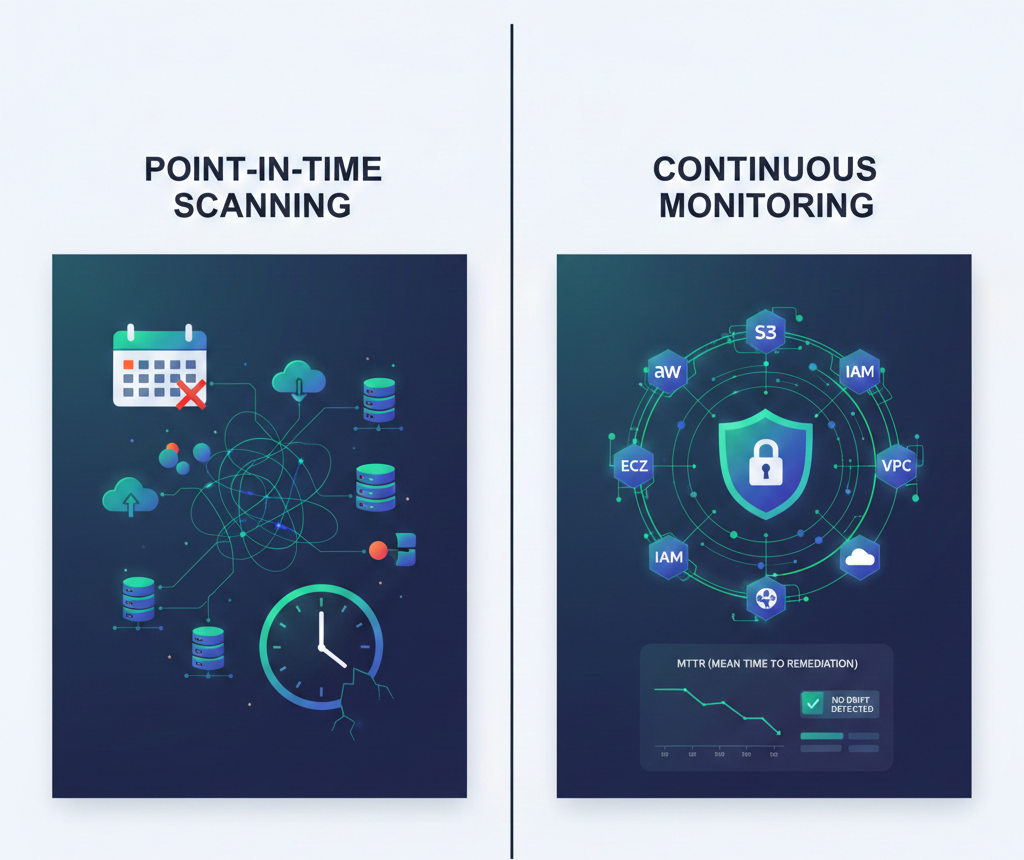
Most teams start their security posture journey with a scheduled scan - run Prowler or a similar tool monthly, review the findings, file some tickets. This is better than nothing, but it has a critical flaw.
Cloud infrastructure changes constantly. Engineers provision new resources, modify security groups, adjust S3 bucket policies, and rotate IAM roles dozens of times per week in active environments. A monthly scan tells you the state of your environment on the day it ran. It tells you nothing about the 29 days in between.
Configuration drift - the accumulation of small, often unintentional changes that move your environment away from its secure baseline - is the main reason cloud security incidents happen. And drift happens continuously, not on your scan schedule.
The Four Dimensions of Cloud Security Posture
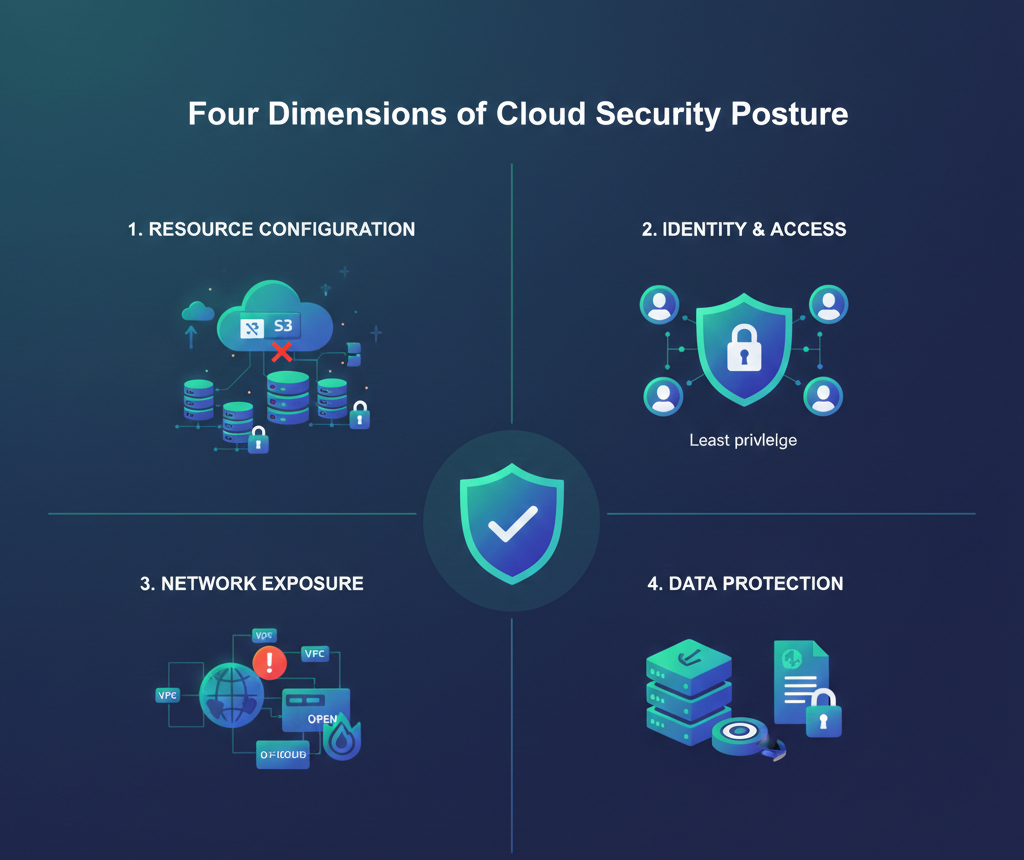
Effective monitoring tracks your environment across four dimensions:
1. Resource Configuration
Are your resources configured according to best practices? This includes:
- S3 buckets with public access disabled
- Security groups without overly permissive ingress rules
- RDS instances with encryption at rest enabled
- EC2 instances using IMDSv2
2. Identity and Access
Are IAM policies following least privilege? This is often the hardest dimension to monitor because IAM configurations are complex and frequently changed by multiple teams.
3. Network Exposure
Which resources are reachable from the internet? This goes beyond just "is port 22 open" - it includes indirect exposure through VPC peering, transit gateways, and load balancer configurations.
4. Data Protection
Are sensitive data stores encrypted? Are backups enabled? Are logs being retained and protected?
Monitoring Approaches Compared
| Approach | Coverage | Freshness | Remediation Support |
|---|---|---|---|
| Manual review | Incomplete | Quarterly at best | None |
| Scheduled scanning (e.g., Prowler) | Comprehensive | Point-in-time | Manual |
| AWS Config rules | AWS resources only | Near real-time | Limited |
| CSPM platform (e.g., Dedups.ai) | Comprehensive | Continuous | Guided |
| Continuous + automated remediation | Comprehensive | Real-time | Automated with dry-run |
Building a Practical Monitoring Program
Define Your Baseline
Before you can detect drift, you need to know what "correct" looks like. Document your security baseline - which configurations are required, which are preferred, and which are acceptable exceptions. This baseline becomes the reference point for all monitoring.
Implement Continuous Scanning
Tools like Dedups.ai run continuous scans against your AWS accounts, comparing current configurations against your security baseline and industry frameworks like CIS Benchmarks and AWS Security Best Practices. When a deviation is detected, it's flagged immediately - not on the next monthly scan.
Create an Actionable Alerting Pipeline
Raw findings aren't useful if they go nowhere. Effective posture monitoring routes findings to the right people through the right channels. Dedups.ai integrates with Slack, Jira, and email to ensure findings reach engineering teams in context - with enough information to act without requiring a separate research process.
Track Remediation, Not Just Detection
The metric that matters isn't how many findings you detect. It's how quickly those findings get remediated. Build dashboards that show mean time to remediation (MTTR) by finding severity, team, and resource type. This shows where your security program has bottlenecks.
Common Mistakes in Posture Monitoring
Alert fatigue: If every finding generates a high-priority alert, teams stop paying attention. Prioritize findings by actual risk - a public S3 bucket containing sensitive data is not the same severity as an S3 bucket with logging disabled.
No owner assignment: Findings without clear ownership don't get fixed. Every resource in your environment should map to a team responsible for it.
Treating monitoring as a compliance checkbox: The goal is reducing real risk, not generating reports. If your monitoring program generates findings that nobody remediates, you have a workflow problem, not a monitoring problem.
Ready to Get Started?
Building continuous cloud security posture monitoring doesn't require a large security team - it requires the right tooling and workflow. Dedups.ai provides continuous posture monitoring, intelligent alerting, and a guided remediation workflow that turns findings into fixed configurations. Start your free assessment today.