IP Vulnerability Scanner: Finding Exposed Attack Surface Before Attackers Do
Your external attack surface - every IP address, every open port, every running service visible from the internet - is being continuously scanned by automated tools operated by threat actors. These scans run 24 hours a day, looking for anything exploitable: unpatched services, default credentials, misconfigurations, exposed management interfaces.
The question isn't whether your IP space is being scanned. It is. The question is whether you're scanning it first, finding the vulnerabilities, and fixing them before someone else exploits them.
What an IP Vulnerability Scanner Does
An IP vulnerability scanner systematically probes IP addresses and port ranges to identify:
- Open ports and running services: Which ports are accepting connections, and what service is responding?
- Service fingerprinting: What software and version is running on each port?
- CVE matching: Does the identified version have known vulnerabilities?
- Configuration issues: Default credentials, weak TLS configurations, exposed admin interfaces
- Network exposure assessment: Which services are accessible from the internet vs. internal networks only?
This information maps your actual attack surface - the specific entry points an attacker would probe and potentially exploit.
External vs. Internal IP Scanning
| Scan Type | Target | Primary Value |
|---|---|---|
| External (black-box) | Public IPs and exposed services | Attacker's perspective - what's visible from internet |
| Internal (white-box) | Private IP ranges within VPC/network | Lateral movement risk - what's accessible post-compromise |
| Both | Complete IP space | Full attack surface mapping |
Most organizations prioritize external scanning correctly - internet-exposed services represent direct attack risk. Internal scanning matters because post-compromise lateral movement is the primary technique used in serious breaches.
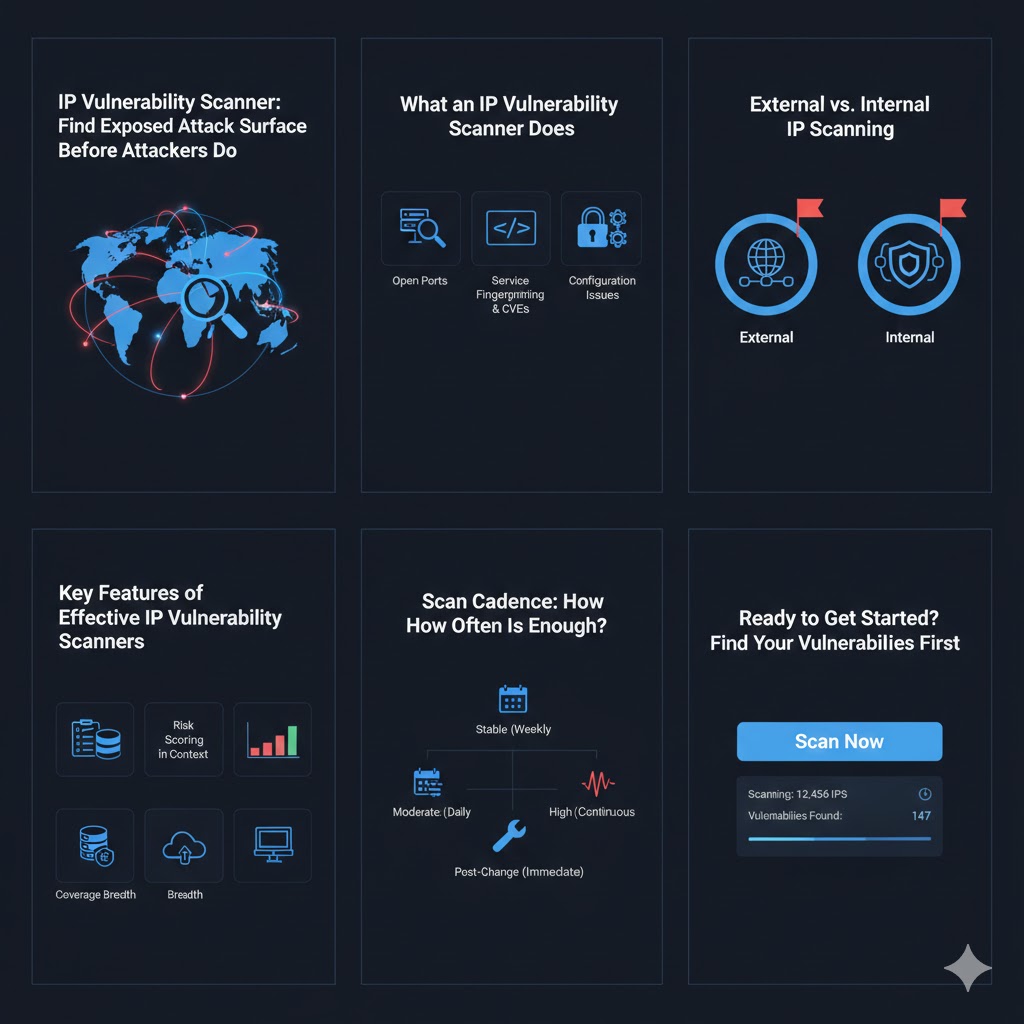
Key Features of Effective IP Vulnerability Scanners
Accurate CVE Matching
The scanner's value is in matching what it finds (software versions, banner information, configuration details) to known CVE records. Quality varies significantly between scanners in both the depth of fingerprinting and the currency of their CVE database.
Risk Scoring in Context
Not all CVEs are equal, and not all CVEs are equally exploitable in your specific environment. A good scanner contextualizes findings - a CVE in a service accessible only to internal IPs is lower priority than the same CVE in a publicly accessible service.
Coverage Breadth
Beyond web services, effective scanners cover:
- Database ports (3306 MySQL, 5432 PostgreSQL, 27017 MongoDB)
- Remote management (22 SSH, 3389 RDP, 23 Telnet)
- Infrastructure services (161 SNMP, 623 IPMI)
- Cloud-specific exposure patterns
Speed at Scale
Scanning thousands of IPs and port ranges across multiple regions needs to complete in a reasonable timeframe. Scanners that take days to complete a full scan of a large environment provide stale results.
Integrating IP Scanning With Your Security Workflow
An IP vulnerability scanner that produces reports without integrating into your remediation workflow creates the same problem as every other disconnected security tool - findings accumulate without action.
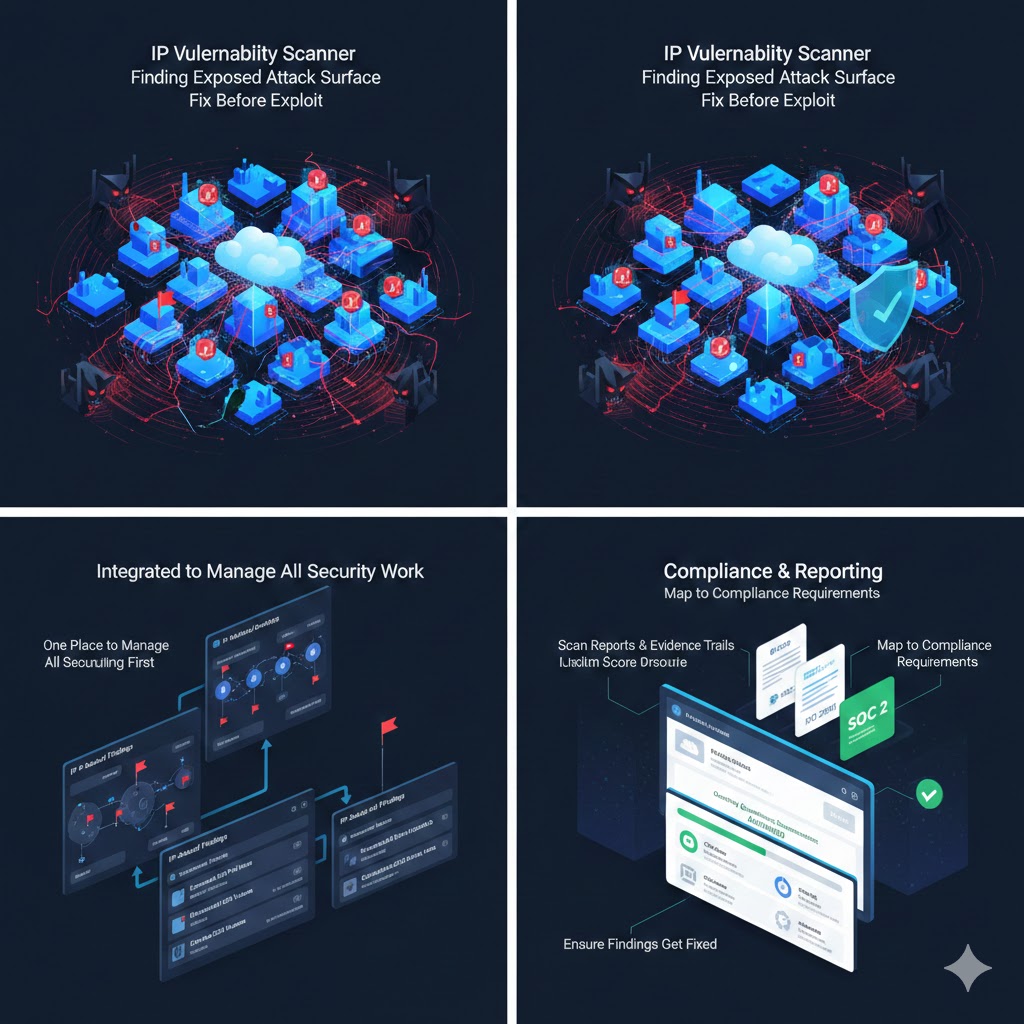
Dedups.ai integrates IP vulnerability scanning with cloud security posture management, so IP-based findings appear alongside misconfiguration findings in the same engineering workflow. A finding about an exposed RDS port appears in the same Jira board as findings about unencrypted EBS volumes - one place for your team to manage all security work.
Scan Cadence: How Often Is Enough?
| Environment Change Rate | Recommended Cadence |
|---|---|
| Stable (rare changes) | Weekly full scan |
| Moderate (weekly deployments) | Daily scan of critical IPs, weekly comprehensive |
| High (daily deployments) | Continuous scanning |
| Post-change verification | Scan immediately after significant network changes |
Compliance Requirements for IP Scanning
Multiple compliance frameworks require regular vulnerability scanning:
- PCI-DSS: Requires quarterly external scans by an Approved Scanning Vendor (ASV) plus internal quarterly scans
- SOC 2: External vulnerability scanning is expected as part of a comprehensive security program
- ISO 27001: A.18.2.3 requires technical vulnerability management
Dedups.ai generates scan reports and evidence trails that map to these compliance requirements - so your quarterly compliance documentation is produced automatically.
Ready to Get Started?
Your external attack surface is being probed right now. Find your vulnerabilities first. Dedups.ai provides continuous IP vulnerability scanning across your public and private IP space, integrated with cloud security posture management and a remediation workflow that ensures findings get fixed - not just documented.