Comprehensive AWS Security: Building a Layered Defense That Actually Works
AWS security isn't something you solve once and move on from. It's a continuous practice of configuring resources correctly, monitoring for drift, responding to threats, and demonstrating that your controls work. The challenge for most engineering teams is that AWS security spans dozens of services, hundreds of configuration options, and multiple organizational layers - and the blast radius of getting it wrong can be significant.
This guide provides a practical framework for comprehensive AWS security - not an exhaustive catalog of every AWS security service, but a clear model for building layered defenses that hold up in practice.
Why "Comprehensive" Matters
Point solutions solve narrow problems. A WAF protects your web tier. GuardDuty detects certain threat patterns. Macie finds sensitive data in S3. But each of these tools operates in isolation, and attackers don't limit themselves to one attack vector.
Comprehensive AWS security means building defenses that are:
- Layered: Multiple controls at different points, so a bypass of one layer doesn't mean full compromise
- Integrated: Tools that share context so security teams get a complete picture
- Actionable: Findings that lead to remediation, not just reports
- Continuous: Monitoring that keeps pace with infrastructure change
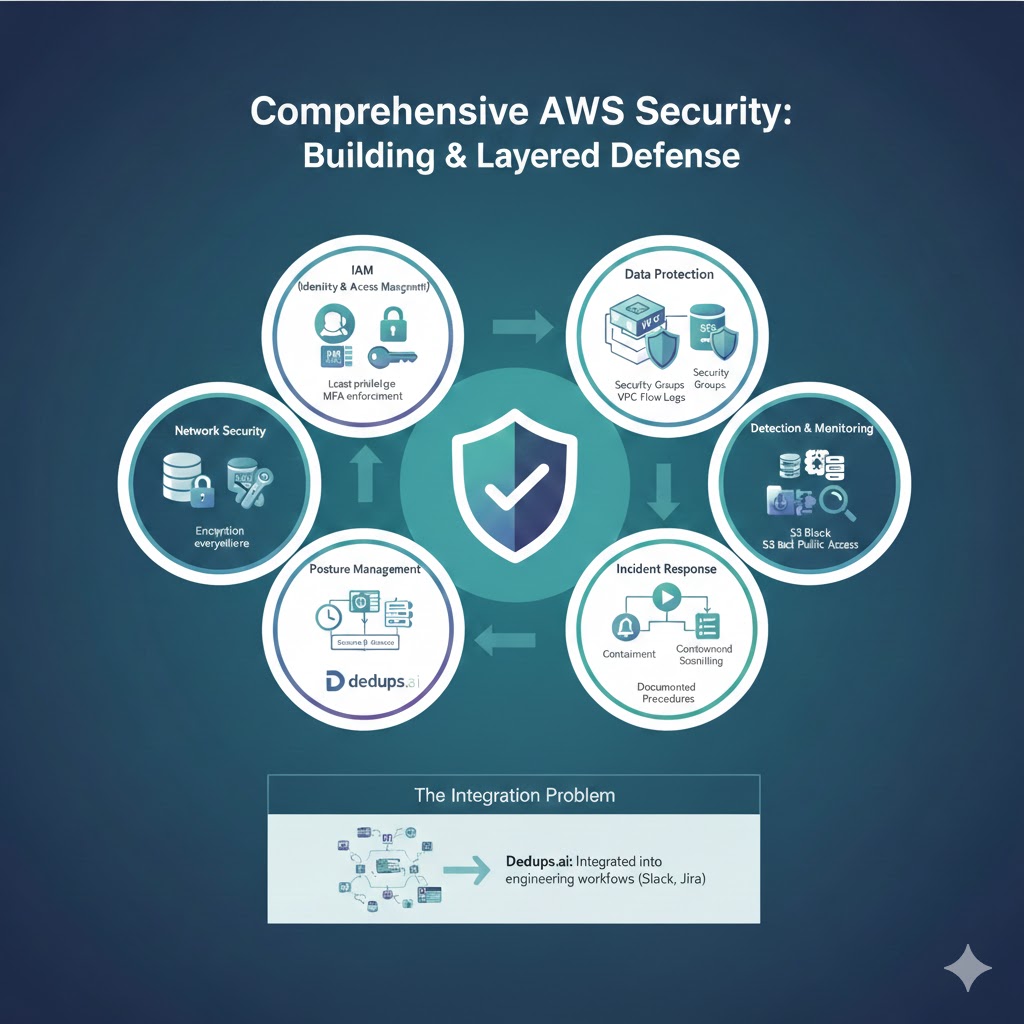
The AWS Security Framework: Six Domains
1. Identity and Access Management (IAM)
IAM is the foundation. Every other security control depends on it. Key principles:
- Least privilege: Grant the minimum permissions required for each role or user
- No root usage: Use IAM roles and users, never the root account for operations
- MFA enforcement: Require MFA for all human users and sensitive operations
- Permission boundaries: Use these to limit what even privileged roles can do
- Access key rotation: Automate detection and rotation of long-lived credentials
2. Network Security
- VPCs with private subnets for sensitive resources
- Security groups as stateful firewalls (avoid 0.0.0.0/0 ingress rules)
- NACLs as a secondary layer for subnet-level control
- VPC Flow Logs for network visibility
- AWS Network Firewall or WAF for application-layer inspection
3. Data Protection
- Encryption at rest for all storage (EBS, RDS, S3, DynamoDB)
- Encryption in transit (TLS everywhere, enforced via S3 bucket policies and load balancer settings)
- AWS KMS with customer-managed keys for sensitive data
- S3 Block Public Access enabled at the account level
4. Detection and Monitoring
This is where most teams underinvest. Detection capabilities include:
| Service | What It Detects | Gap to Supplement |
|---|---|---|
| AWS GuardDuty | Threat intelligence, anomalous API calls | Doesn't cover misconfigurations |
| AWS Config | Configuration compliance | No remediation guidance |
| CloudTrail | API activity logs | Requires analysis to be useful |
| Security Hub | Aggregated findings | Prioritization and remediation still manual |
| Dedups.ai | Misconfigurations + cost waste | Adds remediation workflow |
5. Posture Management
Configuration drift is how breaches start. Posture management tools like Dedups.ai continuously scan your AWS environment for misconfigurations - comparing your actual state against CIS Benchmarks, AWS Foundational Security Best Practices, and your own defined policies. When drift is detected, it routes findings to the right team for remediation.
6. Incident Response
Having controls in place is only part of the picture. You need documented procedures for:
- How to contain a compromised IAM credential
- How to isolate a compromised EC2 instance
- Who gets paged and in what order
- How to preserve forensic evidence
The Integration Problem
Most security programs accumulate tools without connecting them. GuardDuty findings go to Security Hub. Security Hub findings go to a SIEM. Nobody reviews the SIEM unless something very bad happens.
Dedups.ai addresses this by integrating security posture findings directly into engineering workflows via Slack, Jira, and email - so misconfigurations are surfaced in the same context where engineers already work, with the context they need to act.
Compliance as a Side Effect
If you build a genuinely comprehensive AWS security program, compliance becomes easier. Your controls map to ISO 27001, SOC 2, and PCI-DSS requirements. Your evidence is collected automatically by tools like Dedups.ai. Your audit trail is maintained continuously rather than assembled before an audit.
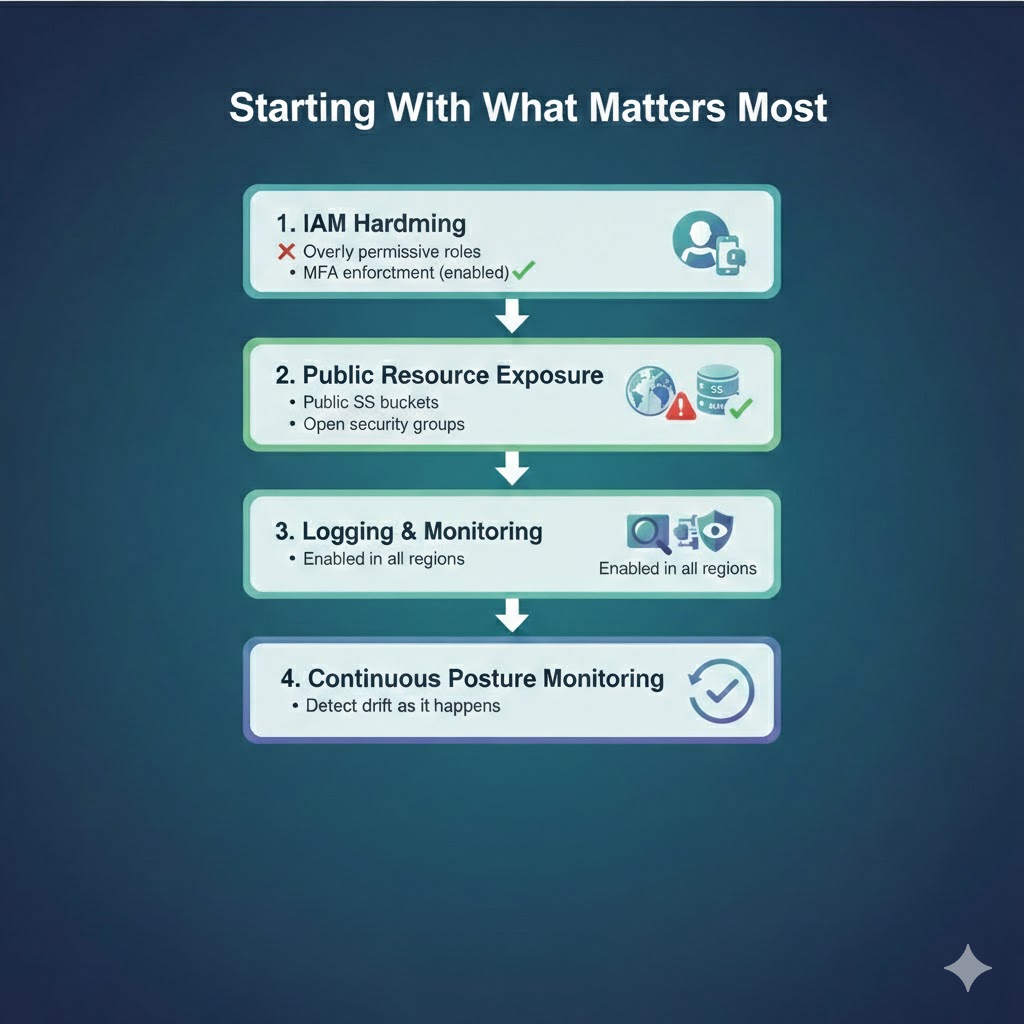
Starting With What Matters Most
If you're building from scratch, prioritize in this order:
- IAM hardening - fix overly permissive roles and enable MFA
- Public resource exposure - identify and remediate public S3 buckets, open security groups, exposed RDS instances
- Logging and monitoring - ensure CloudTrail and GuardDuty are enabled in all regions
- Continuous posture monitoring - implement a tool that detects drift as it happens
- Remediation workflow - ensure findings actually get fixed, not just filed
Ready to Get Started?
Comprehensive AWS security is achievable for teams of any size - it requires a clear framework and the right tools. Dedups.ai provides continuous posture monitoring, guided remediation, and compliance evidence collection that makes your AWS security program defensible under scrutiny.