Cloud Security Tools: A Practical Evaluation Guide for 2026
The cloud security tools landscape is genuinely overwhelming. Hundreds of vendors compete in dozens of overlapping categories, each with demos designed to showcase best-case scenarios and pricing designed to obscure true cost. Engineers and security leaders who rely on analyst reports and vendor comparisons often end up with tools that look great in evaluation but underperform in production.
This guide gives you a practical evaluation framework based on what actually matters when tools are deployed in real environments.
The Categories Worth Knowing
| Tool Category | What It Does | Who Needs It |
|---|---|---|
| CSPM | Detects cloud misconfigurations | Everyone using cloud |
| CWPP | Protects workloads at runtime | Teams with EC2/container workloads |
| API Security | Discovers and tests APIs | Teams with APIs (everyone) |
| IP Scanner | Maps external attack surface | Every internet-connected org |
| IaC Scanner | Catches issues before deployment | Teams using Terraform/CloudFormation |
| Cloud SIEM | Analyzes logs for threats | Teams with compliance requirements |
| CIEM | Manages cloud IAM risk | Large orgs with complex IAM |
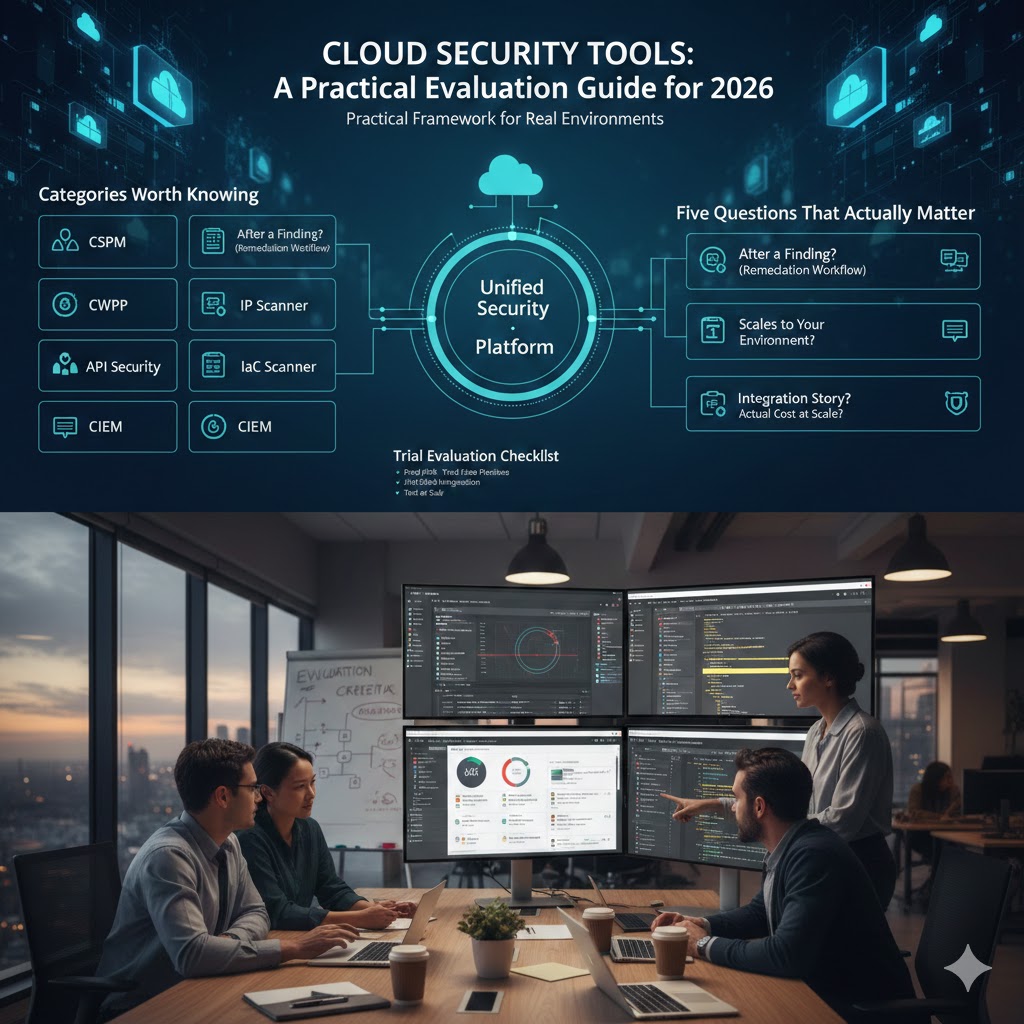
The Five Questions That Actually Matter in Evaluation
1. What Happens After a Finding?
This is the most important question and the one most vendors answer poorly. Detection is a solved problem - every mature CSPM tool finds most of the same misconfigurations. The differentiation is in what happens next.
Does the tool:
- Provide remediation guidance, not just detection?
- Integrate with Jira, Slack, or email to route findings to engineers?
- Track whether findings get resolved?
- Collect evidence that remediation occurred?
Dedups.ai is built around the remediation workflow problem. Every finding includes guided steps, routing, and tracking.
2. What's the False Positive Rate in Practice?
Ask vendors for false positive rates and watch how they respond. Vendors with good tools answer specifically. Vendors with poor tools give vague answers about "noise reduction."
Even better: during a trial, count how many findings are genuine misconfigurations versus acceptable configurations that the tool incorrectly flags. High false positive rates create alert fatigue that undermines your entire security program.
3. How Does It Scale to Your Environment?
A tool that handles a 100-resource demo account may perform poorly against 10,000 resources across 15 AWS accounts and 6 regions. Before committing, test with production-scale data or at minimum ask reference customers with similar environment sizes.
4. What's the Integration Story?
The best cloud security tool in the world doesn't help if engineers don't engage with it. Tools that require logging into a separate portal for every finding get ignored. Evaluate:
- Does it integrate with your existing workflow tools (Jira, Slack, PagerDuty)?
- Can findings be routed to the correct team based on resource ownership?
- Does it support API access for custom integrations?
5. What Does It Actually Cost at Scale?
Many cloud security tools use pricing models that look reasonable at small scale but become prohibitive as your environment grows. Understand:
- Is pricing based on number of resources, cloud spend, or finding volume?
- Are there overage fees?
- What's the total cost at 2x and 5x your current environment size?
The Tool Sprawl Problem
Most security teams accumulate tools over time - a CSPM for misconfigurations, a separate cost optimizer, a vulnerability scanner, an API security tool, an IP scanner. Each was the best solution to a specific problem at the time. Together, they create integration overhead, duplicated scanning costs, and a fragmented view of your security posture.
Dedups.ai consolidates CSPM, cost optimization, API security, and IP vulnerability scanning in a single platform with a single integration and a unified findings workflow. For many teams, this reduces both cost and management overhead compared to maintaining separate tools.

A Trial Evaluation Checklist
When running a proof of concept:
- Connect to your production AWS account, not a demo account
- Count findings and verify a sample for accuracy
- Track false positives over 2 weeks
- Test integration with your Jira or Slack workspace
- Verify a complete remediation workflow from finding to resolution
- Test at scale with your full resource count
Ready to Get Started?
Dedups.ai offers a free assessment of your AWS environment - connecting in minutes to show you your security and cost optimization opportunities with no commitment required. See for yourself how the findings quality and remediation workflow compare to your current tooling.