Cloud Cost Optimization: Reducing Spend Without Sacrificing Performance
Cloud infrastructure is now a core part of how modern companies build and run products. Yet most organizations still overspend significantly on cloud - often by 30–35% - due to idle resources, overprovisioned instances, and missed discount opportunities.
The goal of cloud cost optimization is not simply to "cut costs,” but to align spend with value: paying for the right resources, at the right size, for the right workloads, at the right price.
This article outlines a vendor-neutral, thought-leadership view on cloud cost optimization, including how AI and automation can help, practical optimization levers, and how to build a sustainable, FinOps-aligned practice across AWS, Azure, and Google Cloud.
Why Cloud Costs Spiral Out of Control
Cloud’s pay-as-you-go model enables rapid experimentation and scale - but that same flexibility makes it easy to lose control.
Common drivers of runaway spend include:
- Overprovisioned resources: Instances sized "for peak” that rarely exceed 10–20% utilization.
- Idle or forgotten assets: Stopped instances with attached volumes, unused load balancers, orphaned snapshots, idle databases.
- Lack of cost visibility: Teams cannot see who is spending what, on which services, in which environments.
- Missed pricing optimizations: Underuse of reserved instances, savings plans, sustained-use discounts, and spot/preemptible capacity.
- Multi-cloud complexity: Separate billing models, consoles, and discount programs across AWS, Azure, and GCP.
As environments grow, manual analysis of all this data becomes impractical. This is where AI-assisted cloud cost optimization and a FinOps mindset become powerful: they help organizations continuously translate raw usage data into actionable savings without degrading performance.
Overview: A Modern Approach to Cloud Cost Optimization
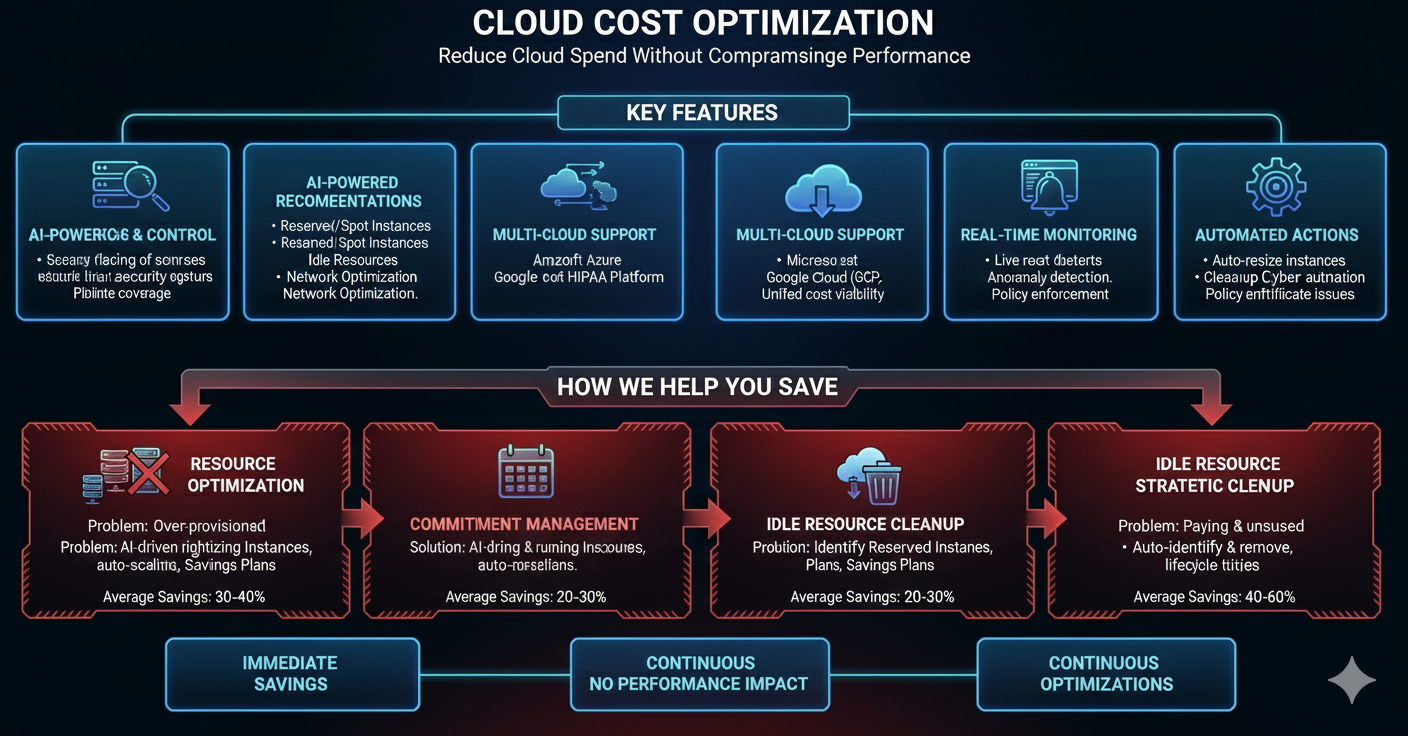
A sustainable cloud cost optimization practice typically combines:
- AI-powered analysis: To process massive billing and telemetry data, detect patterns, and surface optimization opportunities that humans would miss.
- Multi-cloud visibility: A single view of spend across AWS, Azure, and GCP, normalized and enriched with business context (teams, products, features).
- Continuous monitoring: Real-time dashboards, anomaly detection, budget alerts, and forecasting to prevent surprises.
- Operational guardrails: Policies, automation, and workflows that ensure cost efficiency becomes part of day-to-day engineering, not an occasional project.
The end state is not "cheapest possible cloud,” but cost-efficient cloud: environments that deliver required performance, reliability, and security at the lowest sustainable cost.
AI-Powered Recommendations: Turning Data into Savings
Modern cost optimization tools increasingly rely on AI and machine learning to make sense of complex usage patterns. At scale, this kind of number-crunching is only realistic with automation.
Typical AI-driven recommendations include:
Rightsizing
Analyze historical CPU, memory, and I/O utilization to suggest:
- Smaller instance families or sizes where utilization is consistently low.
- Vertical vs horizontal scaling tradeoffs.
- Container and pod resource limit adjustments in Kubernetes clusters.
Studies and real-world implementations often show 30-70% savings on specific workloads through aggressive rightsizing, especially where servers have been sized conservatively for peak demand.
Commitment Discounts
Identify workloads with stable, predictable usage and recommend:
- AWS Reserved Instances or Savings Plans
- Azure Reserved VM Instances
- GCP Committed Use Discounts or Sustained Use Discounts
Well-planned commitments can yield up to 75% discounts compared to on-demand pricing for steady-state workloads.
Spot / Preemptible Capacity
For fault-tolerant, non-critical workloads (batch processing, CI/CD, analytics), AI-driven analysis can:
- Classify suitable workloads for spot/preemptible instances.
- Estimate interruption risk and cost-performance tradeoffs.
- Recommend diversification across regions, AZs, and instance types.
This often delivers 50–70% savings on those workloads, when combined with robust checkpointing and retry strategies.
Idle Resource Detection
AI-based anomaly and pattern detection helps find:
- Instances idle outside of working hours
- Databases with near-zero connections
- Unattached volumes, unused load balancers, orphaned snapshots
- Underused managed services (e.g., message queues, analytics clusters)
Eliminating idle resources commonly contributes 15–25% additional savings on top of rightsizing and commitments.
Storage and Network Optimization
By examining access frequency and transfer patterns, AI systems can recommend:
- Moving infrequently accessed data to lower-cost storage tiers
- Applying lifecycle policies and archival strategies
- Eliminating redundant copies and unnecessary snapshots
- Reducing cross-region or cross-cloud data transfer patterns where possible
Intelligent storage tiering alone can yield 40–60% reductions for storage-heavy workloads.
Multi-Cloud Optimization and Unified Visibility
Many organizations run workloads across AWS, Azure, and GCP, either by design or organically over time. Multi-cloud strategies complicate cost management because:
- Each provider uses different service names, pricing dimensions, and discount models.
- Bills and usage data are siloed in separate consoles and formats.
- Tagging and cost-allocation standards vary by team and platform.
A unified cost visibility layer enables:
- Aggregate and per-cloud views: Total spend vs per-provider breakdown.
- Cost by business dimension: Team, product, feature, environment, or customer segment.
- Comparative analytics: Understanding where particular workloads are most cost-effective.
This visibility is central to FinOps: it allows engineering, finance, and product leaders to make shared, data-driven decisions about where and how to run workloads.
Real-Time Monitoring, Anomaly Detection, and Forecasting
Cloud cost optimization is not a one-off exercise; it is an ongoing operational responsibility.
Effective practices include:
- Live cost dashboards: Up-to-date views of daily and monthly spend by service and team.
- Budget alerts and notifications: Thresholds for accounts, projects, and business units to flag overspend early.
- Anomaly detection: Machine-learning models that detect unusual spikes in spend or usage and highlight likely root causes.
- Forecasting and trend analysis: Predicting future spend based on historical patterns and upcoming projects, helping finance teams plan and allocate budgets.
Real-time insight transforms cloud spend from a surprise line item into a manageable, predictable operational expense.
Core Optimization Levers
1. Resource Optimization
Problem: Overprovisioned compute, memory, and storage lead to chronic underutilization and waste.
Approach:
- Analyze 30–90 days of utilization data.
- Identify consistently underused instances and containers.
- Move to smaller instance sizes or more appropriate families.
- Introduce autoscaling where workloads are variable but predictable.
- Schedule non-production resources to shut down outside business hours.
Typical impact: Many organizations achieve 30–40% compute savings from rightsizing and scheduling alone.
2. Commitment Management
Problem: Relying only on on-demand capacity misses both discounts and predictability.
Approach:
- Identify workloads with stable baselines over long periods.
- Use a layered model: on-demand or spot for variability, commitments for the baseline.
- Diversify across commitment types (RIs, Savings Plans, CUDs) to maintain flexibility.
Typical impact: Well-managed commitments often drive 20–30% savings on steady-state workloads.
3. Idle Resource Cleanup
Problem: Environments accumulate unused resources that continue to incur charges.
Approach:
- Regularly scan for: stopped VMs with attached storage, unattached volumes, unused IPs, idle databases, and unused load balancers.
- Establish policies and automation for cleanup, with safeguards and approvals for critical systems.
Typical impact: Systematic cleanup commonly delivers 15–25% savings, especially in dev/test and ephemeral environments.
4. Storage Optimization
Problem: Storing all data in premium tiers is expensive and rarely necessary.
Approach:
- Classify data by access frequency and retention requirements.
- Use lifecycle policies to move cold data to archival or infrequent access tiers.
- Tune backup and snapshot retention; eliminate duplicates and unnecessary copies.
- Consider compression and deduplication where supported.
Typical impact: Storage-focused efforts can yield 40–60% cost reductions for data-heavy workloads.
Enablers: Visibility, Budget Management, and Automation
Cost Visibility
Effective cost optimization starts with transparency:
- Cost breakdown by service: Compute, storage, network, managed databases, analytics.
- Cost allocation by team, project, and environment: Enabled by consistent tagging or account/ subscription structure.
- Custom reports: Views aligned to how the business thinks - by product, customer, or feature.
Without this level of visibility, it is impossible to hold teams accountable or meaningfully optimize against business value.
Budget Management
Budgets and alerts guide behavior:
- Create budgets per team, product, and environment.
- Track utilization in real time and set thresholds for warnings and hard stops.
- Combine budgets with forecasts to adjust plans proactively, not reactively.
This is a core element of FinOps: teams own their costs and are empowered with data to control them.
Automated Actions
Automation eliminates toil and enforces guardrails:
- Scheduled start/stop for non-production environments.
- Auto-resizing based on utilization thresholds.
- Automatic cleanup of clear waste (e.g., long-unattached volumes), with approval workflows for borderline cases.
- Policy-driven enforcement (e.g., no untagged resources, blocked creation of oversized instances in dev accounts).
The principle is simple: automate the obvious, engineer the complex. Basic rightsizing and cleanup can be automated, freeing engineers to focus on architectural and performance optimizations that deliver deeper savings and better reliability.
Measuring ROI
To sustain support from leadership, cloud cost initiatives must demonstrate:
- Gross savings: Dollar and percentage reductions over time.
- Net savings: After accounting for tool costs and engineering time.
- Business impact: Improved margins, extended runway, or reinvestment into innovation.
Tracking before/after baselines and presenting trends via executive-friendly dashboards keeps optimization efforts funded and prioritized.
Who Benefits: Startups, Enterprises, and Service Providers
Startups
- Control burn rate and extend runway.
- Align infrastructure spend with revenue and growth targets.
- Prove unit economics to investors and stakeholders.
For early-stage teams, disciplined cost optimization can be the difference between hitting the next milestone or running out of cash.
Enterprises
- Reduce large, entrenched cloud bills by a meaningful percentage.
- Implement FinOps best practices at scale, with shared responsibility across engineering, finance, and operations.
- Enable cross-team chargeback/showback to drive accountability.
- Optimize multi-cloud strategies where applicable.
MSPs and Agencies
- Improve client margins through cost-efficient architectures.
- Offer cost optimization as an ongoing managed service.
- Use cost transparency and savings as proof of value in client relationships.
Implementation Journey: From Discovery to Continuous Optimization
A practical approach to cloud cost optimization often follows three phases.
Phase 1: Discovery and Baseline
- Connect cloud accounts across providers.
- Establish a clear baseline: current spend, utilization patterns, and top cost drivers.
- Identify obvious quick wins (e.g., idle resources, clear overprovisioning).
Phase 2: Optimization and Execution
- Prioritize actions based on potential savings and implementation risk.
- Implement rightsizing, commitments, storage tiering, and cleanup, using automation where possible.
- Closely monitor performance to ensure no negative impact.
Phase 3: Ongoing FinOps and Continuous Improvement
- Introduce regular cost reviews and cross-functional FinOps rituals.
- Continuously ingest data, apply AI-driven recommendations, and refine policies.
- Evolve tagging strategies and account structure to improve visibility and governance.
Cloud environments and workloads change constantly; optimization must keep pace.
Closing Thoughts
Cloud cost optimization is no longer a niche concern for "the finance team.” It is a core engineering and business capability. The combination of AI-powered analysis, strong visibility, and disciplined FinOps practices allows organizations to:
- Cut unnecessary spend, often by 20–40% or more across major workloads.
- Maintain or improve performance and reliability while reducing costs.
- Make cloud spend predictable, explainable, and aligned with business value.
For founders, engineers, and IT leaders, the question is not whether to optimize cloud costs - it is how to build a sustainable, data-driven practice that continuously keeps infrastructure efficient as the company grows.
References
- https://vlinkinfo.com/blog/case-study-of-cloud-cost-optimization
- https://spacelift.io/blog/cloud-cost-optimization
- https://www.cloudoptimo.com/blog/rightsize-your-cloud-for-peak-performance-and-reduced-costs/
- https://www.mgt-commerce.com/blog/cloud-cost-optimization-maximizing-efficiency-and-cost-savings/
- https://spot.io/resources/cloud-cost/cloud-cost-optimization-15-ways-to-optimize-your-cloud/
- https://cloudgov.ai/resources/blog/ai-powered-cloud-cost-management-for-the-enterprise/
- https://www.tangoe.com/report/finops-ai-how-to-hyper-automate-cloud-cost-optimization/
- https://amnic.com/blogs/ai-in-finops
- https://www.cloudoptimo.com/blog/9-essential-finops-best-practices-for-cloud-cost-optimization/
- https://www.cloudzero.com/blog/rightsizing/