API Security & Discovery: Discovering, Monitoring, and Securing Your APIs
APIs are now at the heart of modern application architecture, connecting microservices, third-party integrations, mobile clients, and cloud workloads. Yet their distributed nature makes them difficult to track and secure. Most organizations struggle with incomplete visibility into their API ecosystem - and that blind spot is where attackers find opportunity.
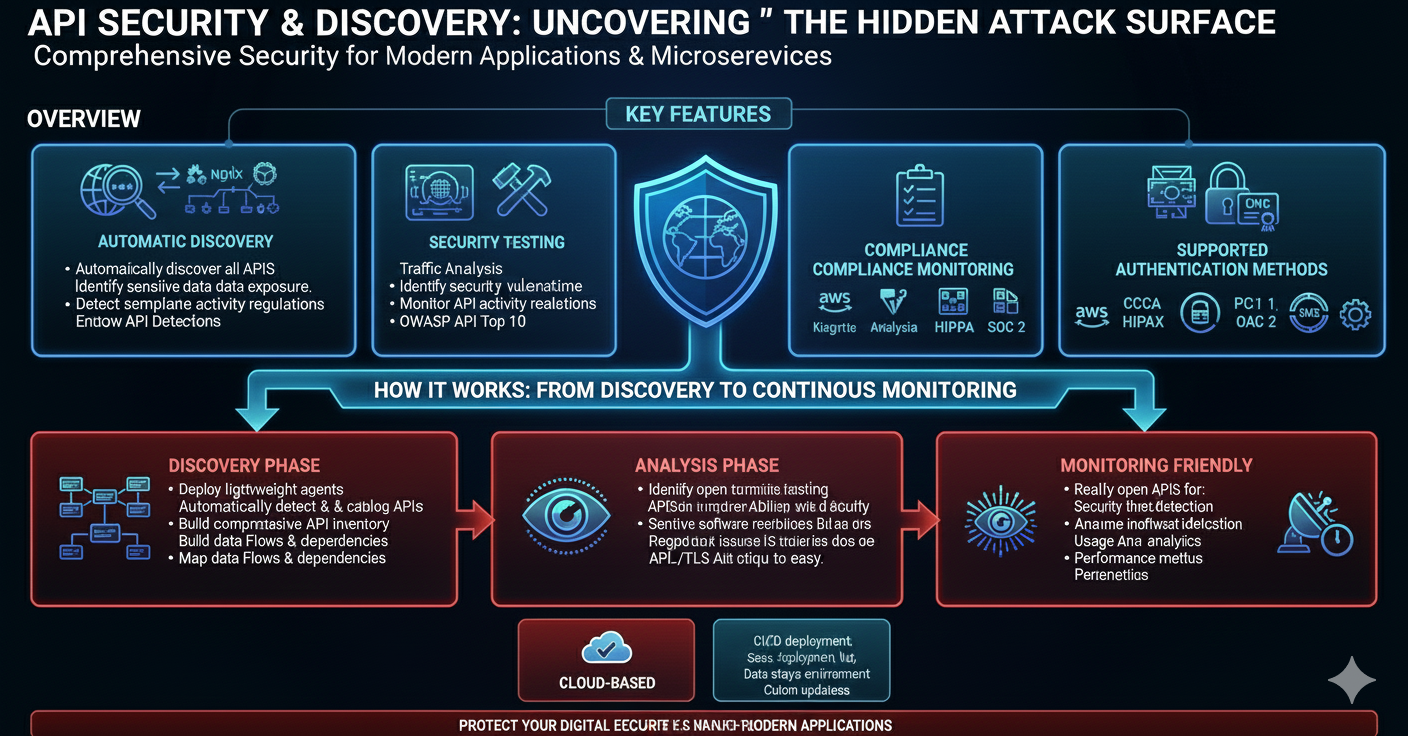
Comprehensive API discovery, continuous security testing, and real-time monitoring form the foundation of an effective API security strategy. This article explores why systematic API security is essential for organizations of any size, the risks of incomplete approaches, and how to build a more resilient API security program.
The API Security Crisis Is Real
The stakes are high. In 2025, 99% of organizations reported at least one API security incident within the prior 12 months. The most commonly exploited vulnerabilities were injection attacks and Broken Object Level Authorization (BOLA), together accounting for over one-third of all incidents. These are not theoretical risks - they are actively exploited, often by automated tools deployed at scale.
The core problems organizations face are straightforward:
Discovery is hard. Many APIs remain undocumented or forgotten, living in development environments that still accept production requests. Employees deploy test services, sidestep governance processes, or simply forget about endpoints after projects end. This creates shadow APIs - unmanaged, unsecured, and invisible to traditional tools.
Access control is inconsistent. Different teams manage different API endpoints using different authentication methods. Some rely on outdated OAuth flows, others use weak API keys, and some may not require authentication at all. This inconsistency creates easy entry points for unauthorized access.
The attack surface keeps growing. Each new endpoint, integration, or microservice adds complexity. Each one handles user input, permissions, and sensitive information - all of it potential attack surface that must be understood and protected.
Why API Discovery Matters
An API discovery process is the ongoing, systematic effort to identify and catalog all internal and external APIs within an organization. This is no longer optional for businesses running cloud-native or microservices architectures.
The Shadow API Problem
Shadow APIs are the most visible manifestation of discovery failure. These are undocumented or unofficial APIs that operate outside standard governance processes - often created by development teams to support specific projects, features, or experiments.
Shadow APIs present several specific risks:
They bypass security controls. Shadow APIs may not undergo rigorous security checks, vulnerability testing, or access control reviews before deployment. Without governance oversight, they accumulate quickly and are forgotten just as fast.
They create unpredictable data flows. When undocumented endpoints handle sensitive information (PII, PHI, financial data, or proprietary business logic), the data flows become invisible to compliance and security teams. This creates audit and regulatory compliance gaps.
They become prime targets. Attackers use automated discovery tools to scan entire IP ranges looking for APIs. An undocumented API with no monitoring or rate limiting is an obvious target - especially if it was never patched or hardened.
Types of APIs and Discovery Methods
APIs exist in many forms, each requiring different discovery approaches:
Direct APIs: Documented, managed endpoints that are known and tracked. These are the easiest to discover through official API catalogs and documentation.
Shadow APIs: Undocumented or forgotten endpoints, discovered through network traffic analysis, log inspection, and behavioral scanning.
Internal APIs: Microservices and inter-service communication within containerized environments (Kubernetes, Docker, etc.). These require agent-based or traffic-based discovery.
Third-party and integrated APIs: External services consumed by the organization. These require dependency scanning and security assessment of external providers.
Discovering all of these requires multiple techniques working together: analyzing network logs, comparing deployed services against documentation, scanning for unknown hosts or endpoints, and continuously monitoring for new additions.
What Can Go Wrong Without Comprehensive API Security
The consequences of incomplete API security visibility and testing can be severe and cascading.
Data Breaches Through Unmanaged Endpoints
APIs that handle sensitive data without proper authentication or encryption become natural targets for data exfiltration. Common scenarios include:
Excessive data exposure: APIs return full data sets without proper filtering or masking, inadvertently exposing PII, payment card details, health information, or trade secrets.
Broken authentication: Weak or missing authentication mechanisms allow attackers to impersonate legitimate users or applications and access protected resources without authorization.
Injection flaws: SQL injection, command injection, and other input-validation failures allow attackers to execute arbitrary commands or manipulate API logic to extract sensitive data.
Attackers actively scan for these patterns using freely available tools. Once discovered, they are trivial to exploit at scale, often compromising thousands of API instances simultaneously.
Compliance and Regulatory Violations
Many industries operate under strict data protection regulations. Incomplete API governance creates compliance gaps that can trigger significant penalties:
GDPR violations: European regulations require strict data minimization, proper consent mechanisms, and documented access controls. Shadow APIs handling personal data without these controls create compliance exposure.
HIPAA gaps: Healthcare organizations must maintain audit trails of all access to protected health information and enforce role-based access controls. Undocumented APIs handling PHI bypass these requirements.
PCI-DSS failures: Payment processing APIs must enforce encryption, rate limiting, access controls, and immutable audit logging. Unmanaged payment endpoints almost certainly violate these standards.
SOC 2 control failures: Service organizations must demonstrate consistent security controls. Unmonitored APIs become impossible to audit, compromising SOC 2 compliance claims.
The costs of non-compliance extend beyond penalties - they include incident response, customer notification, reputation damage, and potential loss of business certifications.
Operational Disruption and Service Outages
Even when no breach occurs, unmanaged APIs can cause operational chaos:
Cascading failures: A compromised or misconfigured API in one service can propagate failures across dependent microservices, causing widespread outages.
Lateral movement: An attacker exploiting a single vulnerable API can use it as a beachhead to move laterally through the network, compromising additional systems.
Rate-limit abuse: APIs without rate limiting can be abused for denial-of-service attacks, consuming resources and degrading performance for legitimate users.
Incident response complexity: When an API incident occurs, the first challenge is often determining what "normal" even looked like. Without historical baselines and ongoing monitoring, forensic analysis becomes exponentially harder and slower.
Building Effective API Discovery
Systematic API discovery requires multiple techniques working in concert.
Discovery Methods
Traffic analysis: Passive monitoring of network logs and traffic patterns identifies actual API calls being made, even if they are not documented. This method catches shadow APIs and reveals actual usage patterns.
Agent-based discovery: Lightweight agents deployed in Kubernetes clusters, Nginx servers, or application containers automatically detect and catalog APIs as they are deployed.
Log inspection: Analyzing access logs, deployment logs, and change logs reveals APIs that were created, modified, or deprecated. Historical logs surface forgotten endpoints.
Comparison and inventory: Comparing actual deployed services against official documentation and asset inventories reveals discrepancies - areas where shadow APIs exist.
Behavioral analysis: Continuous monitoring of API traffic patterns, endpoint additions, permission changes, and data flows helps identify anomalies and new exposures over time.
Building an API Inventory
The output of API discovery should be a comprehensive, searchable, up-to-date inventory that includes:
- All discovered endpoints (documented and undocumented)
- Service names, versions, and owners
- Authentication methods and access control policies
- Data classification (what types of data each API handles)
- Deployment environment (cloud, on-prem, hybrid)
- Last modified date and deployment history
- Known vulnerabilities and remediation status
This inventory becomes the foundation for risk prioritization, compliance auditing, and security testing.
Testing APIs for Common Vulnerabilities
Once APIs are discovered and inventoried, systematic security testing should follow. Most organizations benefit from testing against the OWASP API Top 10 - a community-maintained list of the most critical API security risks.
Key Vulnerabilities to Test For
Broken authentication (BOLA #1 in exploits): Verify that each API endpoint enforces authentication correctly, rejects invalid credentials, and maintains secure session handling.
Broken authorization and access control: Test that users can only access resources and perform actions their role permits. Verify that BOLA vulnerabilities do not exist - where object IDs can be manipulated to access unauthorized resources.
Excessive data exposure: Confirm that APIs return only the minimum data necessary and do not leak sensitive fields (PII, credentials, internal IDs) in responses.
Injection flaws: Test for SQL injection, command injection, XML injection, and other input-validation failures by submitting malicious payloads to API parameters.
Insecure direct object references: Verify that API endpoints validate object ownership before returning or modifying data.
Security misconfiguration: Check for missing security headers, weak TLS/SSL configurations, verbose error messages, and outdated dependency versions.
Insufficient logging and monitoring: Confirm that API calls are logged with sufficient detail (identity, timestamp, action, outcome) for audit and incident response.
Rate limiting and resource constraints: Verify that APIs enforce rate limits to prevent abuse and have safeguards against resource exhaustion.
Insecure API keys: Test that API keys are properly rotated, never hardcoded or exposed, and scoped to minimal necessary permissions.
Unsafe consumption of external APIs: For APIs that call third-party services, verify that inputs are validated and outputs are properly handled, even if the external service is compromised.
Testing Approaches
Manual testing: Security experts can perform targeted testing against high-risk APIs, especially for business logic vulnerabilities that require human insight.
Automated scanning: Specialized API security scanning tools can efficiently test large numbers of endpoints against common vulnerability patterns.
Simulation and behavioral analysis: Real-world attack simulation - where the scanner behaves like an actual attacker - reveals logical flaws and authorization bypasses that signature-based scanning might miss.
Penetration testing: For critical APIs, formal penetration testing by external security specialists can uncover complex, multi-step exploitation chains.
The most effective approach combines automated coverage (for breadth) with targeted manual testing (for depth and business logic analysis).
Real-Time Monitoring and Compliance
Discovery and testing are not one-time activities. APIs change constantly - new versions are deployed, authentication mechanisms are updated, permissions shift, and new dependencies are added. Continuous monitoring is essential to maintain visibility and control.
What to Monitor
API traffic patterns: Baseline normal usage (request volume, geographic sources, request types) and alert when traffic deviates significantly. This catches unauthorized access, rate-limit abuse, and potential breaches.
Authentication and authorization events: Log all authentication attempts (successful and failed), permission changes, and access to sensitive data.
API modifications: Track when new endpoints are deployed, existing endpoints are modified or removed, and versions are deprecated.
Dependency changes: Monitor for security updates in external APIs, client libraries, and dependency versions that your APIs use.
Vulnerability status: As new CVEs are published, continuously scan APIs for exposure to newly disclosed vulnerabilities.
Compliance Monitoring
For regulated industries, monitoring must also demonstrate compliance with applicable standards:
GDPR: Audit trails must show when personal data is accessed and by whom. APIs must enforce data minimization, proper consent, and access restrictions.
HIPAA: Comprehensive logging of PHI access is mandatory, including identity, timestamp, type of access, and outcome. Access control must enforce role-based permissions.
PCI-DSS: All payment API interactions must be logged and monitored for suspicious patterns. Encryption, rate limiting, and access controls must be actively validated.
SOC 2: Controls over API security must be documented, tested, and monitored continuously to support audit and attestation claims.
Real-time monitoring dashboards that surface API security events and compliance status are essential for maintaining control in complex, rapidly changing environments.
Supporting Authentication and Authorization
APIs support a wide variety of authentication and authorization mechanisms. Effective API security requires understanding each mechanism and how to implement it securely.
Common Authentication Methods
Basic authentication: Username and password transmitted in HTTP headers. Only safe when combined with HTTPS encryption. Best suited for simple, internal APIs or legacy integrations.
API keys: Long random strings issued to users and applications, transmitted in headers or request bodies. Require careful rotation and secrets management. Suitable for programmatic access but should never be hardcoded in applications.
Bearer tokens (JWT): Self-contained tokens that encode identity and permissions. Stateless and scalable but require careful expiration and validation logic.
OAuth 1.0 / 2.0: Industry-standard delegation protocols that allow users to authorize third-party applications without sharing passwords. OAuth 2.0 is the modern standard and supports multiple grant types for different use cases.
AWS Signature: API signing mechanism that proves the identity of AWS principals. Commonly used for AWS service-to-service authentication.
Mutual TLS (mTLS): Both client and server present certificates, enabling strong, cryptographic mutual authentication. Suitable for service-to-service communication in microservices architectures.
Authorization Best Practices
Role-Based Access Control (RBAC): Map users to roles, and roles to permissions. This simplifies management and reduces the chance of overprivilege.
Granular permissions: Move beyond broad "read" and "write" permissions. Use fine-grained permissions like "read_customer_data", "create_order", "delete_subscription" so that each API key or token can be scoped to minimal necessary access.
Request-level authorization: Implement middleware that checks permissions on every request, enforcing that the authenticated user/application has access to the specific resources being requested.
Audit logging: Maintain immutable records of authorization decisions - who accessed what, when, and whether the request was allowed or denied.
Deployment Considerations
API security tools and processes can be deployed in multiple ways, each with tradeoffs.
Cloud-Based (SaaS)
Advantages: No infrastructure to manage, automatic updates and scaling, accessibility from anywhere, lower upfront costs.
Considerations: Data is processed outside the organization's environment, which may conflict with data residency or sovereignty requirements. Integration with internal systems may require API connections or agent-based data collection.
On-Premises
Advantages: Complete data control, data stays in the organization's environment, can be customized for specific infrastructure or compliance needs.
Considerations: Requires dedicated infrastructure investment and maintenance, manual updates and scaling, higher operational overhead.
Hybrid
Advantages: Balance of control and convenience. Leverage cloud for analysis and dashboards while keeping sensitive data on-premises.
Considerations: More complex to manage, requires bidirectional integration between systems.
The choice depends on the organization's infrastructure, data sensitivity, regulatory requirements, and operational capacity.
Building a Comprehensive API Security Program
Effective API security requires integration across multiple teams and disciplines.
Key Program Components
API inventory and governance: Maintain a searchable, up-to-date inventory of all APIs. Enforce standards for naming, versioning, documentation, and security controls.
Secure development practices: Integrate security testing into the CI/CD pipeline so that vulnerabilities are caught before APIs reach production.
Security training: Ensure developers and architects understand common API vulnerabilities (OWASP Top 10) and how to defend against them.
Incident response: Establish procedures for responding to API security incidents, including investigation, communication, and remediation.
Compliance and audit: Map API security controls to compliance requirements, maintain audit trails, and conduct regular compliance validation.
Threat modeling: For high-risk APIs, conduct threat modeling exercises early in design to identify attack vectors and appropriate mitigations.
Tools and Automation
The most effective programs combine several tool categories:
Discovery and inventory tools: Automatically identify APIs and maintain searchable inventories.
API security testing platforms: Automated scanning against common vulnerabilities, combined with manual testing capabilities for complex logic.
API monitoring and analytics: Real-time traffic analysis, anomaly detection, and compliance dashboards.
API gateways: Centralized policy enforcement for authentication, rate limiting, encryption, and logging.
Automation handles scale and consistency, but human judgment - from architects, security engineers, and developers - is essential for context, prioritization, and business-aligned decision-making.
Closing Thoughts
APIs are now integral to how modern applications work. They enable rapid development, cloud-native architectures, and seamless integrations. But each API expands the attack surface and creates new places where security can fail.
An effective API security program combines comprehensive discovery (finding all APIs, including shadow APIs), continuous security testing (against known vulnerabilities), real-time monitoring (detecting malicious or anomalous activity), and compliance auditing (demonstrating control to regulators and business stakeholders). No single tool or technique covers everything - security requires a layered, systematic approach.
For security-conscious founders, engineers, and IT leaders, investing in API security is not optional. The question is not whether to do it, but how to do it efficiently and sustainably alongside rapid development and constant infrastructure changes. Starting with discovery - understanding what you have - is the essential first step.
References
- https://cybelangel.com/blog/the-api-threat-report-2025/
- https://www.apisec.ai/blog/secure-your-shadow-apis-best-practices-for-api-discovery
- https://www.pynt.io/learning-hub/owasp-top-10-guide/owasp-api-top-10
- https://www.syncloop.com/blogs/03-04-2025/syncloops-approach-to-api-compliance-gdpr-hipaa-and-more.html
- https://stackoverflow.blog/2021/10/06/best-practices-for-authentication-and-authorization-for-rest-apis/
- https://www.checkpoint.com/cyber-hub/cloud-security/what-is-application-security-appsec/what-is-api-security/7-api-security-issues-in-2025-and-how-to-deal-with-them/
- https://www.radware.com/cyberpedia/application-security/api-discovery-process/
- https://application.security/free/owasp-top-10-API
- https://www.linkedin.com/pulse/api-security-ensuring-compliance-data-privacy-how-solving-goyal-tlpuc
- https://gocobalt.io/blog/9-best-practices-for-api-authentication-and-authorization-2/