Advanced IP Scanner Vulnerability Detection: Beyond Simple Port Scans
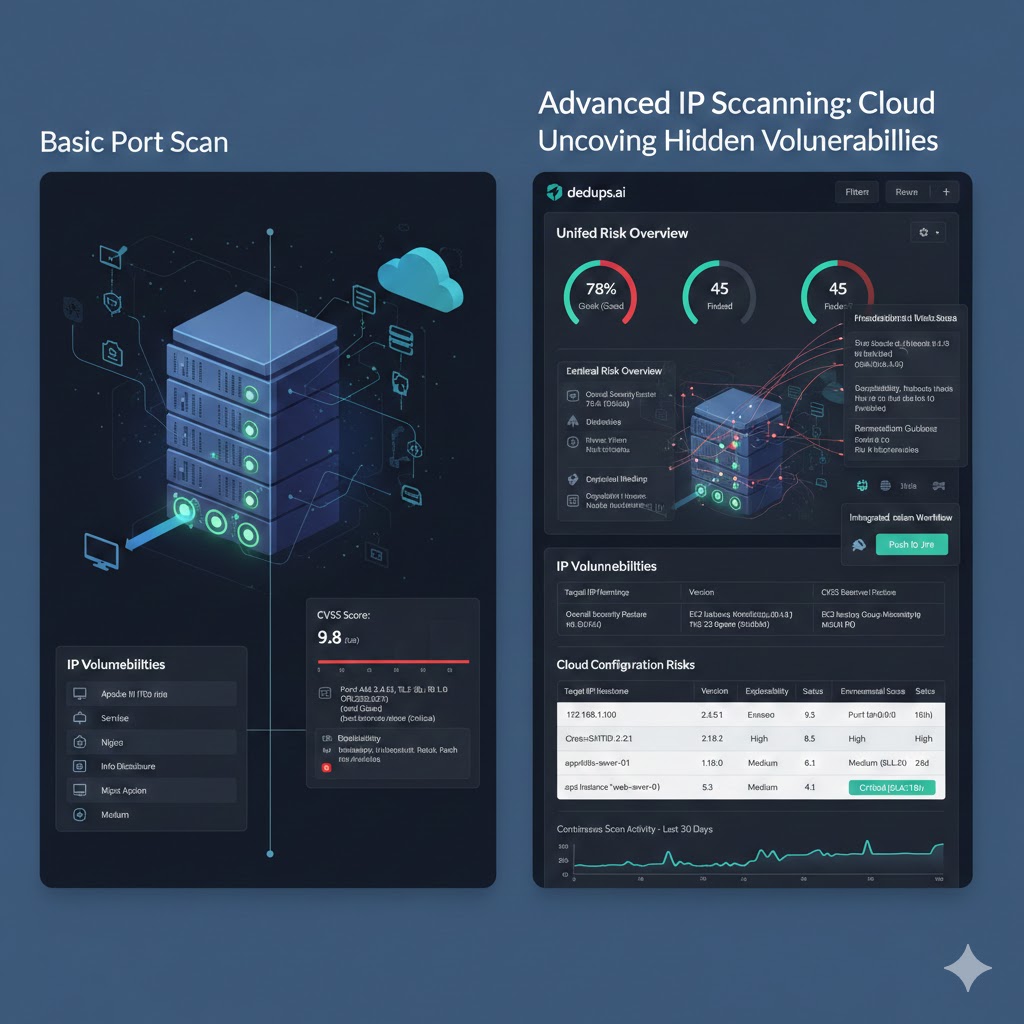
A basic port scan tells you which ports are open. An advanced IP vulnerability scanner tells you what's running on those ports, whether it's vulnerable, how exploitable the vulnerability is, and what an attacker could do if they exploited it. The difference between these two capabilities determines whether you're documenting your attack surface or actually reducing it.
What Makes an IP Scanner "Advanced"
Basic scanners: SYN scan → open port list → done.
Advanced scanners add multiple layers of analysis on top of port discovery:
| Layer | Basic Scanner | Advanced Scanner |
|---|---|---|
| Port discovery | ✅ | ✅ |
| Service identification | Partial (port → assumed service) | ✅ (banner grabbing, fingerprinting) |
| Version detection | ❌ | ✅ (service version extracted) |
| CVE matching | ❌ | ✅ (version → CVE database lookup) |
| Configuration analysis | ❌ | ✅ (TLS version, cipher suites, auth) |
| Contextual risk scoring | ❌ | ✅ (exposure + exploitability + impact) |
| Remediation guidance | ❌ | ✅ |
Service Fingerprinting: The Key Capability
The most important advancement beyond basic port scanning is accurate service fingerprinting - determining not just that port 443 is open, but that it's running Apache 2.4.51 with TLS 1.0 enabled and a self-signed certificate.
This matters because the vulnerability database doesn't contain entries for "open HTTPS port." It contains entries for "Apache HTTP Server 2.4.51 - CVE-2022-22721 (heap-based buffer overflow)" and "TLS 1.0 - BEAST, POODLE, CRIME vulnerabilities."
Without accurate version detection, CVE matching is impossible and your scanner is documenting ports, not vulnerabilities.
CVE Matching and CVSS Scoring
Once service versions are identified, matching against CVE databases (NVD, CVE, vendor advisories) provides the vulnerability intelligence:
CVSS Base Score: Theoretical severity of the vulnerability (0–10) CVSS Environmental Score: Adjusted for your specific environment (Is it internet-accessible? Is there sensitive data involved?) Exploitability: Are active exploits available? Is it being actively exploited in the wild?
Good advanced scanners use all three dimensions - not just CVSS base score - for prioritization. A CVSS 9.8 vulnerability in a service that's only accessible within a private VPC may be lower priority than a CVSS 6.5 vulnerability in a public-facing authentication service with a Metasploit module available.
Configuration Vulnerability Detection
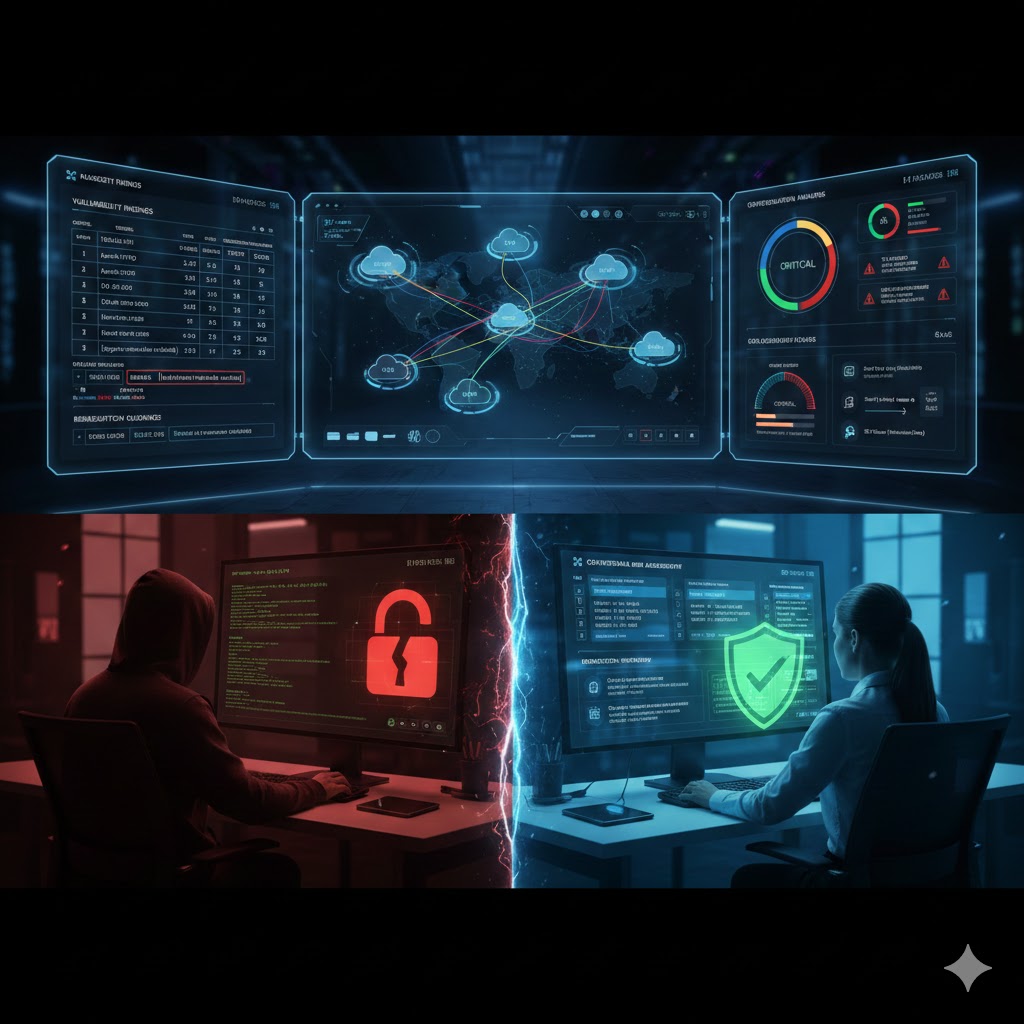
Beyond CVE matching, advanced scanners test for configuration vulnerabilities that don't have CVE identifiers but represent real risk:
TLS/SSL Configuration:
- Protocol version support (TLS 1.0/1.1 should be disabled)
- Cipher suite weakness (export ciphers, RC4, DES)
- Certificate validation issues (expired, self-signed, hostname mismatch)
Authentication Exposure:
- Services responding to default credentials
- Authentication bypass conditions
- Exposed authentication endpoints without rate limiting
Information Disclosure:
- Server version disclosure in headers
- Error messages revealing internal details
- Debug interfaces accessible without authentication
Dedups.ai's Advanced IP Scanning Approach
Dedups.ai integrates advanced IP vulnerability scanning with cloud security posture management, creating important synergies:
Cloud-aware context: For AWS environments, Dedups.ai correlates IP scan findings with cloud configuration data. A vulnerable service on an EC2 instance also appears in the context of that instance's security group configuration, IAM role, and associated data stores - giving a complete risk picture.
Integrated remediation workflow: Scan findings route through the same Jira/Slack/email integration as cloud posture findings. Engineers see IP vulnerabilities in the same queue as misconfiguration findings.
Continuous scanning: Rather than periodic manual scans, Dedups.ai runs continuous scanning against your public IP space - detecting new vulnerabilities as services change.
Building a Scanning Program
Scope definition: Enumerate all public IP addresses associated with your AWS environment - Elastic IPs, EC2 public IPs, load balancer IPs, and DNS records resolving to your IP space.
Scan frequency: Daily for critical and production systems, weekly for staging and non-critical environments.
Finding triage process: Define SLAs - critical findings (CVSS 9+, active exploit, internet-exposed) within 24 hours; high findings within 1 week; medium within 30 days.
Integration with patch management: IP scan findings for unpatched software should feed into your patch management process automatically.
Ready to Get Started?
Advanced IP vulnerability scanning reveals what basic port scanners miss - the specific vulnerabilities attackers use to gain initial access. Dedups.ai provides continuous advanced IP scanning integrated with cloud security posture management, giving your team a complete, prioritized view of your external attack surface with a built-in remediation workflow.